Where You Can (and Can't) Smoke in Japan, Including Street Fines
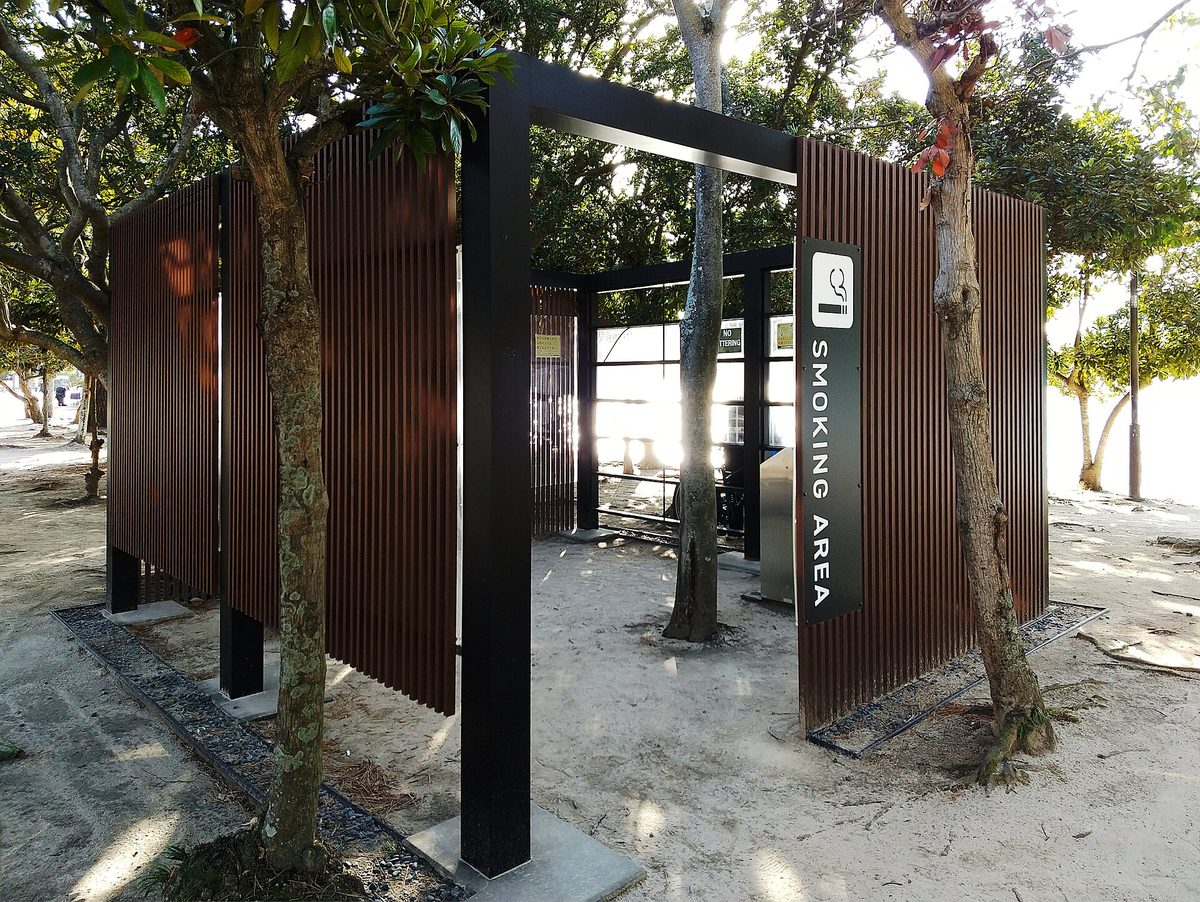
Japan can be confusing for smokers. You may see people smoking in a bar, then walk outside and find a sign on the pavement saying smoking on the street is banned, with a fine. Both can be true at once, because the rules come from two different places: a national law about smoking indoors, and city and ward ordinances about smoking outdoors that change from one city to the next. This guide sorts out which is which, lists the street fines in the places visitors go most, using the cities' own pages, and shows how to find a legal place to smoke without stress.
This page may contain affiliate links. If you buy through them, we may earn a commission at no extra cost to you.
- Law or manners? The two layers of smoking rules
- Street fines in Chiyoda, Shibuya and Shinjuku (Tokyo), Nagoya (Aichi), Osaka (Osaka) and Kyoto (Kyoto)
- Do heated tobacco products (like IQOS) count?
- How to find a smoking area quickly
Please read this first. This is a plain-English guide, not legal advice. Street-smoking rules are set by each city or ward and are updated from time to time. The amounts below are from each city's official page as checked in October 2026; please confirm on the pages linked at the end, and follow the signs where you are.
Two layers: indoors (national law) and outdoors (local rules)
Indoors. Under Japan's revised Health Promotion Act, fully in force since April 1, 2020, facilities used by two or more people (restaurants, offices, shops, hotels, entertainment venues) are, in principle, smoke-free indoors. Smoking is allowed only in smoking rooms that meet technical standards. That is why you see glass-walled smoking rooms in stations and cafés. The Tokyo Metropolitan Government also has its own ordinance on top of this.
Outdoors. There is no single national rule for smoking on the street. Instead, many cities and wards have ordinances that ban street smoking in some or all areas, and some of them collect a fine on the spot (過料, karyo, an administrative fine, not a criminal one). This is where visitors get caught out, because the rule changes when you cross a ward boundary.
So the honest answer to "is it illegal to smoke on the street in Japan?" is: it depends on the city, and in the busiest tourist areas, the answer is usually yes.
Street fines in popular areas
Below is a summary for five places visitors go most. For more local rules in each place, see our destination pages for Tokyo (Tokyo), Osaka (Osaka) and Kyoto (Kyoto).
Chiyoda City (Tokyo): Tokyo Station, Akihabara and Marunouchi (Tokyo)
The ordinance of Chiyoda City (Tokyo) has been in force since October 1, 2002, and the whole ward (except the Imperial Palace) has been a no-street-smoking area since April 1, 2010. Smoking on roads and designated public places is fined 2,000 yen (the ordinance allows up to 20,000 yen; the city sets 2,000 yen "for the time being"). Both cigarettes and heated tobacco are covered. City staff carrying ID give notice, and you pay in cash on the spot or later with a payment slip. Outside the banned places, the ordinance still asks everyone not to smoke while walking in public.
Shibuya City (Tokyo): Shibuya Crossing, Harajuku and Ebisu (Tokyo)
Since April 2019, Shibuya (Tokyo) has banned smoking in all outdoor public places in the ward: roads, parks, plazas. It's not just walking while smoking; the city says standing still, or smoking on a bicycle or motorbike, is also covered. The fine is 2,000 yen, including heated tobacco (the city names IQOS, glo and Ploom). Patrol staff collect it on the spot, and you can pay in cash, by electronic payment, or later with a slip. The city also says that not knowing about the rule is not accepted as an excuse, citing a 2014 Tokyo High Court ruling.
Shinjuku City (Tokyo): Shinjuku Station and Kabukicho (Tokyo)
Shinjuku (Tokyo) bans smoking on the street across the whole ward. The city runs public smoking areas, including at Shinjuku Station's East Exit and West Exit, by the Seibu-Shinjuku Station, the Southeast Exit, Takadanobaba Station and Shinanomachi Station.
Nagoya City (Aichi)
Nagoya (Aichi) has named four no-smoking districts around Nagoya Station, Sakae, Kanayama and Fujigaoka (Aichi). Smoking on the road in these districts is fined 2,000 yen (the ordinance allows up to 20,000 yen). City staff on patrol tell the smoker to put the cigarette out, collect the 2,000 yen and give a receipt; staff carry ID and must show it if asked.
Osaka City (Osaka)
From January 27, 2025, Osaka (Osaka) banned street smoking throughout the city, on the roads, parks, plazas and other public places that the city manages. Heated tobacco was added at the same time. Patrol officers collect a 1,000 yen fine. Osaka (Osaka) publishes a smoking area map; the mayor said about 300 places had been secured when the ban started.
Kyoto City (Kyoto)
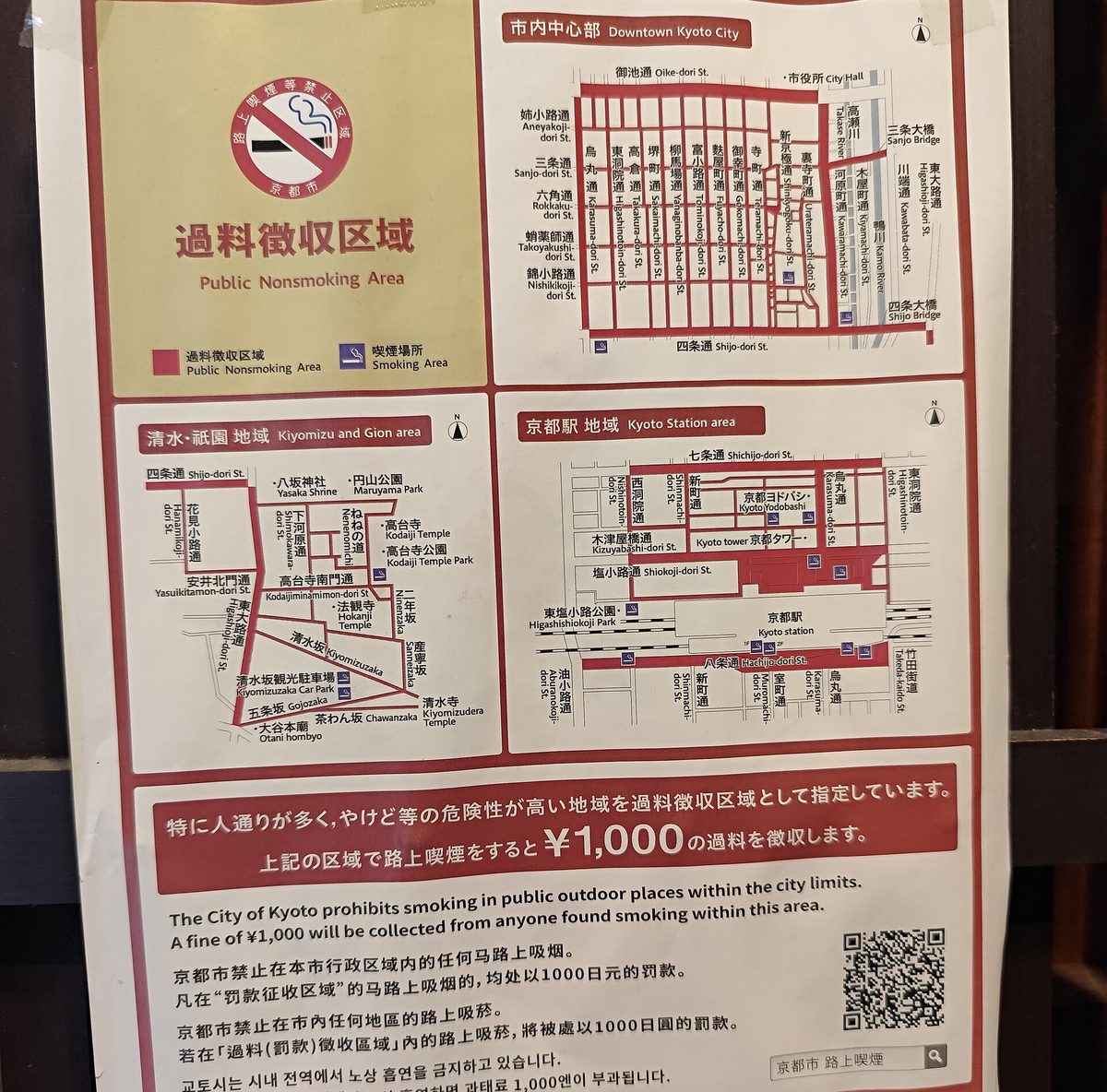
Kyoto (Kyoto) asks everyone not to smoke in outdoor public places anywhere in the city, and collects a 1,000 yen fine in designated busy areas where burns and other harm are more likely. Those areas are marked by signs and shown on the city's map; they have included central Kyoto (Kyoto), the Kyoto Station area and the area around Kiyomizu and Gion (Kyoto). Only the city's monitors, who wear ID on the chest, collect the fine, and they give a receipt issued by Kyoto City (Kyoto).
Asked to pay a smoking fine? Real staff carry ID and, in Kyoto (Kyoto), give a city receipt. If something feels wrong, ask to see ID first. See scams that pretend to be official.
How to smoke without worrying
- Assume the street is off-limits in central Tokyo (Tokyo), Osaka (Osaka) and Kyoto (Kyoto), and look for a designated smoking area instead.
- Search the city's official smoking area map (search for the city's name plus "smoking area map"), or look for the glass smoking rooms in stations and shopping buildings.
- Heated tobacco counts in Chiyoda (Tokyo), Shibuya (Tokyo) and Osaka (Osaka). Treat it like a cigarette.
- Carry a portable ashtray. Dropping a butt is itself banned under many of these ordinances.
- Look down: many bans are marked with signs painted on the pavement, as Shibuya (Tokyo) points out.
If you smoke, a little planning goes a long way: find the smoking spots near your hotel and the stations you use most, and you'll never have to think about the fines at all.
Last reviewed: October 4, 2026. Ordinances and designated areas change. Please confirm the latest information on the official pages below.
References
- Chiyoda City (Tokyo): Living Environment Ordinance (Japanese)
- Chiyoda City (Tokyo): Living Environment Ordinance FAQ (Japanese)
- Chiyoda City (Tokyo): Outline of the ordinance (Japanese)
- Shibuya City (Tokyo): Shibuya (Tokyo) smoking rules (Japanese)
- Shinjuku City (Tokyo): Street smoking banned across the ward / public smoking areas (Japanese)
- Shinjuku City (Tokyo): Indoor smoking banned in principle from April 1, 2020 (Japanese)
- Osaka City (Osaka): Street smoking ban expanded to the whole city (Japanese)
- Osaka City (Osaka): Mayor's press conference, January 24, 2025 (Japanese)
- Kyoto City (Kyoto): Ordinance on street smoking (Japanese)
- Kyoto City (Kyoto): Public smoking areas and fine-collection areas