Lining Up and Giving Way in Japan: Where People Queue, Why, and How to Join In
Spend a day in Japan and you'll stand in a lot of lines: on the station platform, at the taxi stand, outside a famous ramen shop, at a temple's photo spot. Lines here are usually quiet and tidy, and newcomers sometimes wonder what the unwritten rules are. This guide covers the practical side first, from floor marks on the platform to numbered tickets at popular shops, using what railways, cities and dictionaries actually say. Then it looks at a question many visitors ask: why do so many people in Japan line up so carefully? Our answer is one way to see it, not the only one. Last come a few words about yuzuru, giving way, and some phrases that make joining a line easy.
This page may contain affiliate links. If you buy through them, we may earn a commission at no extra cost to you.
- At stations: line up at the floor marks and let people off first
- At popular sights and shops: look for the end-of-line sign, numbered tickets or an app
- Why people line up: our take is a mix of consideration and caring what others think, which grows into trust
- Giving way (yuzuru), and the phrases to ask "Is this the line?"
Everyday lines: stations, taxis and counters
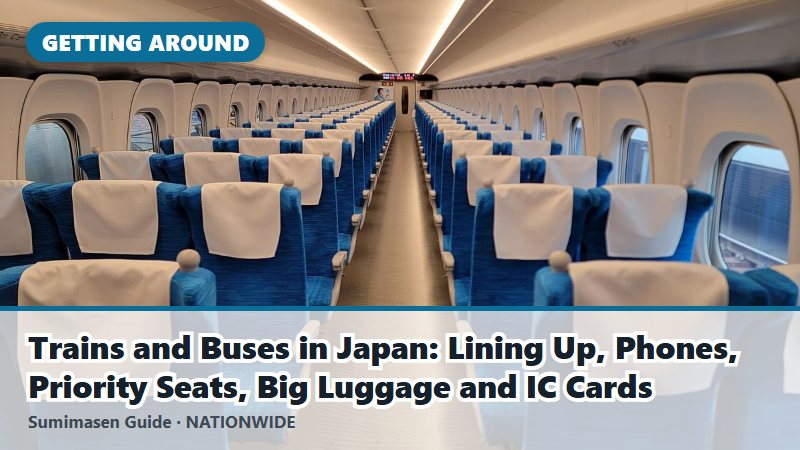
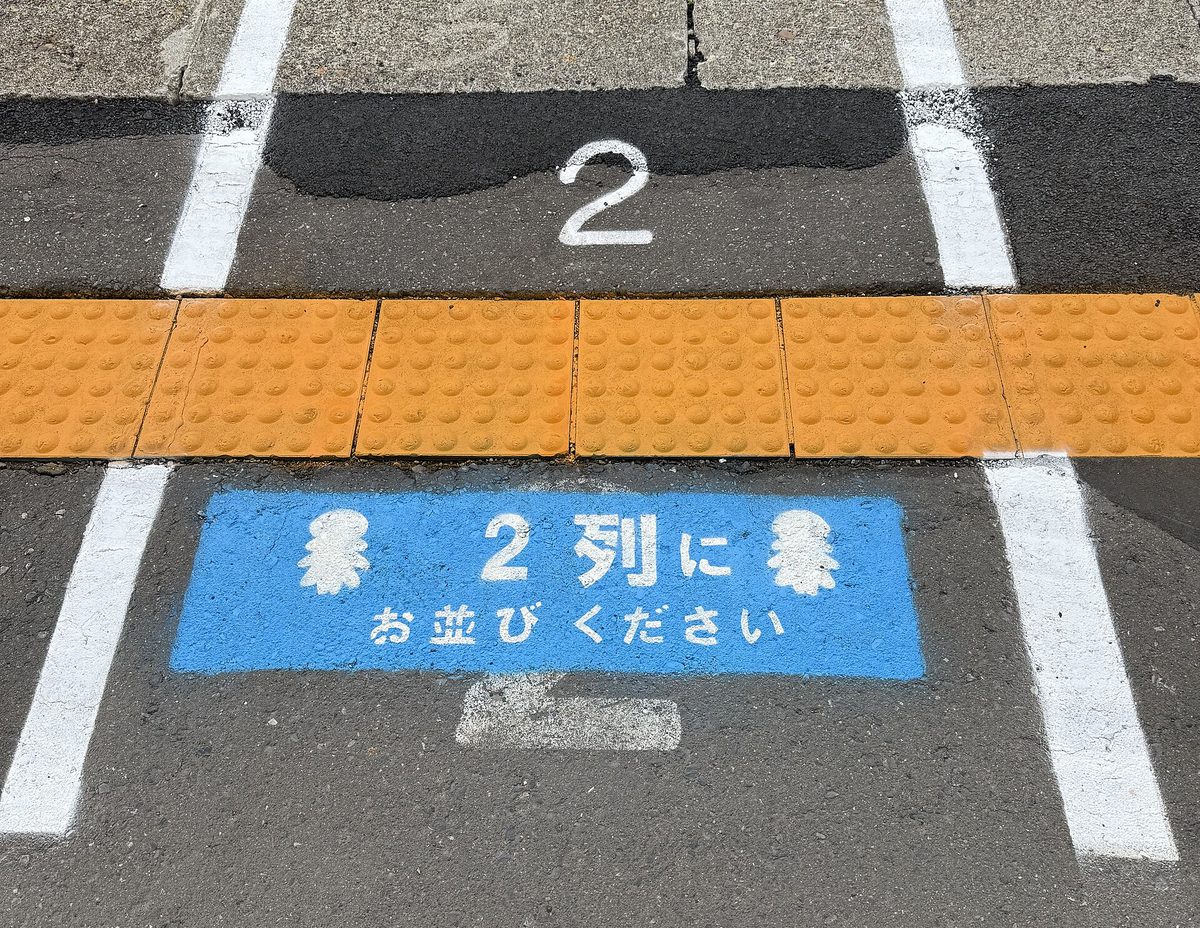
Train platforms. Most platforms have marks on the floor showing where the train doors will stop, and people wait there in rows. Fukuoka City Subway asks passengers to line up in order on the black lines, and not to stand in the blue "getting-off area" in front of the door. Meitetsu, a railway in Nagoya (Aichi), asks passengers to let people getting off go first, and says that cutting into the line bothers the people waiting. For phones, priority seats and suitcases on trains, see our guide to trains and buses in Japan.
Getting on and off still matters to people here. In the Japan Private Railway Association's 2025 survey of 5,202 people, who could each choose up to three behaviors they find most annoying at stations and on trains, "manners when getting on and off, such as rushing onto the train or cutting into the line" was chosen by 20.0 percent and came 8th. Standing around the doors, a new item that year, came 4th with 27.6 percent. Among people who chose getting on and off, 22.9 percent said boarding without waiting for people to get off bothered them most, and 18.9 percent said cutting into the line.
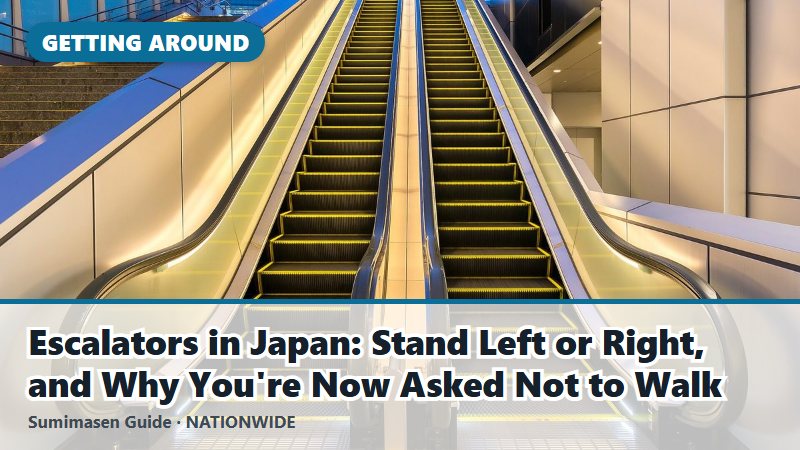
- Escalators: the custom of standing on one side, and the official request to stand still, are explained in escalators in Japan.
- Station elevators: the transport ministry asks that people in wheelchairs, with strollers and others who need elevators can use them without long waits; see priority seats and the Help Mark.
- Taxi stands: at big stations, people wait for taxis in a line at the taxi stand (takushi noriba). The official travel guide of Kyoto (Kyoto) says the stands at major stations such as Kyoto Station get long lines in the busy seasons, and suggests using a taxi app and planning ahead.
- One line for many counters: at toilets, ATMs and ticket windows, you'll often see a single line that feeds whichever counter or stall is free next. Japanese calls this foku narabi, the "fork line", because the one line splits like the prongs of a fork. Join the single line rather than picking a counter.
- Saving a spot outdoors: at cherry blossom time, people spread mats in parks to save a picnic spot (basho-tori). Each park sets its own rules: for example, the Gyoen National Garden around the Imperial Palace in Kyoto (Kyoto) asks visitors not to save spots with blue tarps or mats in ways that block cherry blossom viewing and walking.
Lines at popular sights, shops and restaurants
At famous restaurants, sweet shops, character shops and viewpoints, waiting is part of the day. A few habits make it smoother for you and for everyone around you.
- Find the end before you join. Look for a sign reading 最後尾 (saikobi, "the end of the line"), or ask a staff member. A line can bend around a corner or continue across the street, so the end isn't always where it looks.
- Check how the shop takes turns. Some places use a sign-up sheet at the door, numbered tickets (seiriken), or a place in the queue booked on an app or LINE, so the line you see may not be the whole line. Our guides to Chiikawa shops, conveyor-belt sushi chains, teamLab Planets and Sanrio Puroland show how a few popular places do it.
- Line up with your whole group. Some restaurants ask that the whole group be in line, or seat a group only when everyone is there. Holding a place for friends who will turn up later often bothers the people behind you, so wait to join until everyone has arrived.
- The line can close. When food sells out, a shop may stop the line, sometimes with a sign such as 売り切れ (urikire, sold out) or 本日終了 (honjitsu shuryo, closed for today).
- Keep the path clear. Leave room for people walking past, and don't block the entrance of the shop next door. In Shin-Okubo in Shinjuku (Tokyo), for example, the city asks people waiting in front of shops not to block the way for others.
- Shorter waits: come right at opening time or on a weekday, and use a time reservation when the place offers one.
- Photo spots: at temples, observation decks and popular photo spots, people often wait for their turn to take a picture. Take your shots, then step aside for the next person.
| Sign | Meaning |
|---|---|
| 最後尾 saikobi | End of the line |
| こちらにお並びください kochira ni onarabi kudasai | Please line up here |
| 整理券 seiriken | Numbered ticket |
| 売り切れ urikire | Sold out |
| 本日終了 honjitsu shuryo | Closed for today |
Why do people line up? One way to see it
Watch a quiet line form on a platform at rush hour, and a question comes naturally. Do people line up out of consideration for others? Or because they don't want to be criticized by the people around them?
Our take is that it's both, mixed together. Many people in Japan grow up hearing hito ni meiwaku o kakenai, "don't cause trouble for other people", from their parents and teachers. Children also learn early that others are watching: when everyone around you is waiting in line, stepping out of it feels uncomfortable. And they practice taking turns again and again, from serving school lunch (kyushoku) and lining up for morning assemblies to sports days and the train ride to school.
With enough repetition, a rule learned from parents and the eyes of others can turn into something more like trust. If 100 people are ahead of you and nobody cuts in, your turn will come. You don't need to push or watch your back; the line itself keeps your place for you.
That may be why cutting in can draw such a strong reaction. To many people it feels less like bad manners and more like breaking a fairness that everyone has been keeping together. Put another way, it's not so much that people love lining up; it's that they dislike seeing someone gain by not lining up.
Lining up isn't something only Japan does. People line up in many countries; what differs is where they do it and how, such as one line or several, taking a numbered ticket, or how closely people stand. Every place has its own sense of what's fair, and none of them is the "right" one. Japan's way is simply one of them, and it's easy to pick up.
You don't need any special knowledge to join this circle of trust. Step to the end of the line, wait your turn like everyone else, and the people around you will treat you as one of the line.
Giving way: what yuzuru means
The Japanese verb yuzuru (譲る) means to give something to someone else, and also, as the Digital Daijisen dictionary puts it, to put yourself after others and let them go first, as in giving up your seat or giving up your turn. You'll see it in small moments every day:
- "Osaki ni dozo" (After you). People say it at doors, in elevators, or when two people reach the same gap at the same time. A small open-hand gesture may come with it.
- Letting people off first on trains and elevators, as above.
- Stepping aside on narrow streets. On a narrow path or a busy shopping street, people often stop for a moment against the side to let someone pass.
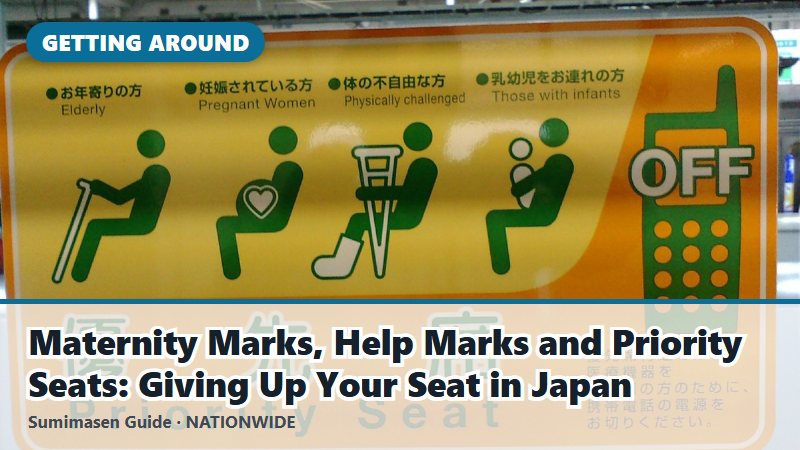
Giving way to people who may need it more, such as older people, people with disabilities, pregnant people and parents with small children, isn't only about priority seats. It can be letting them go ahead in a line, leaving the elevator for them and taking the stairs beside the escalator, or waiting a moment on a narrow street. Fukuoka City Subway, for example, asks passengers to give priority seats to the people who need them. Some needs aren't easy to see: the Maternity Mark and the Help Mark are there for that (see priority seats, the Maternity Mark and the Help Mark). Do it when you can, without fuss, and don't worry if someone politely says no; offering is already kind.
What you can do as a visitor
- Follow the marks on the floor. At stations and shops, lines and footprints show where to stand.
- Join at the end. Look for 最後尾, or the person at the back, before you step in.
- Not sure? Ask. "Is this the line?" in English, or one of the phrases below, works fine. People are usually happy to point.
- Say "sumimasen" when you pass in front of someone or need to get through a line.
- Let people off first, and step aside when someone needs to pass.
| English | Japanese |
|---|---|
| Is this the line? | これは列ですか? Kore wa retsu desu ka? |
| Where is the end of the line? | 最後尾はどこですか? Saikobi wa doko desu ka? |
| Are you in line? | 並んでいますか? Narande imasu ka? |
| After you. | お先にどうぞ Osaki ni dozo |
| Excuse me. | すみません Sumimasen |
This page, like every page on this site, is written under our promise not to criticize visitors, the people who live in Japan, or anyone's politics, religion, race or nationality. More on getting around: trains and buses in Japan and escalators in Japan.
Last reviewed: October 13, 2026. How shops and stations manage lines changes. Please check the official pages below and any signs on the spot.
References
- Japan Private Railway Association: Ranking of annoying behavior at stations and on trains, 2025 (Japanese)
- Fukuoka City Subway: Improving boarding manners (Japanese)
- Meitetsu (Nagoya Railroad): Manner improvement efforts (Japanese)
- Kyoto City (Kyoto) official travel guide: Taxis (Japanese)
- Shinjuku City (Tokyo): Please follow the "Shin-Okubo rules" (Japanese)
- Ministry of the Environment: Requests for cherry blossom viewing at Gyoen National Garden, Kyoto (Kyoto) (Japanese, March 16, 2023)
- Kotobank: Yuzuru (Digital Daijisen and other dictionaries) (Japanese)
- Kotobank: Foku narabi, the fork line (Digital Daijisen) (Japanese)
- Kotobank: Saikobi, the end of a line (Japanese)