Luggage Forwarding in Japan (Takkyubin) and Coin Lockers: Send Bags to Your Next Hotel or the Airport, Costs and Locker Sizes
Japan is easy to travel around, until you try to do it with a large suitcase. Station stairs, crowded commuter trains, city buses and narrow streets in Kyoto all get harder with a big bag. The good news is that Japan has a very well-developed way to travel "hands-free": you send your suitcase ahead by luggage forwarding (takkyubin, door-to-door delivery) and carry only a day bag. This guide explains how to send a bag to your next hotel or to the airport using the official English pages of Yamato Transport and Sagawa Express, how far ahead to send it, what it costs, and how coin lockers work for the hours in between.
If you are worried about getting this wrong, you're not alone: most first-time visitors have never used a delivery service like this at home. It takes about five minutes at a hotel front desk once you know the steps.
This page may contain affiliate links. If you buy through them, we may earn a commission at no extra cost to you.
- Normal luggage forwarding arrives the next day, or in two days to some areas, not the same day
- Sending to the airport: drop the bag off at least 2 days before your flight (3 days from some areas) and collect it at the airport counter on your departure day
- You can send from many hotel front desks, convenience stores and delivery company offices; same-day delivery is only from special counters
- Prices depend on the size (length + width + height) and distance; a suitcase is usually in the 140 to 160 cm range
- Station coin lockers are for a few hours; a large check-in suitcase may not fit, so check the size first
How luggage forwarding works
Luggage forwarding is the same parcel service Japanese people use to send things home, and travelers use it to send suitcases between hotels, airports and homes. The two big companies with English information for visitors are Yamato Transport (its service is called TA-Q-BIN, with the black cat logo) and Sagawa Express (its visitor program is called SAGAWA Hands-Free Travel).
- Normal delivery takes a day or two. Yamato's English FAQ says TA-Q-BIN usually delivers the next day, or in two days, from the day you hand over the bag, basically anywhere in Japan (except some areas).
- Same-day delivery is a special service. Yamato says same-day delivery is only possible when you drop the bag off at a same-day delivery counter, before that counter's cut-off time, to an address inside its service area. Miss the cut-off and the bag arrives the next day or later.
- You fill in a waybill. At a hotel, airport or other facility with a TA-Q-BIN counter, you pick up a waybill there and fill it in. Yamato says advance reservations can't be made for this, and some places let you enter the details on your smartphone and print the waybill.
Sending a bag to your next hotel
This is the most common use: you check out of your Tokyo hotel, send the suitcase to your Kyoto hotel, and ride the Shinkansen with only a day bag.
- Ask the front desk the day before. Yamato says you can send from a hotel if its reception works with Yamato Transport, and only to a hotel where the front desk can receive luggage. Check both hotels in advance.
- Plan for the bag to arrive a day early. Yamato's example: if you stay from February 1, send the bag so that it arrives by January 31. Pack one night's clothes, chargers and medicine in your day bag.
- Write the next hotel's name, address and your name as it appears on your booking. The front desk can help with the address.
- Pay and keep the receipt.
Staying in a vacation rental with no staff? Yamato notes that delivery isn't possible where nobody can receive the bag. In that case you can take the bag to a convenience store (such as 7-Eleven or FamilyMart) or a Yamato sales office to send it, and choose a hotel or a sales office as the destination.
Sending a bag to the airport
Sending your suitcase to the airport lets you sightsee on your last day and pick the bag up just before check-in. Yamato's Airport TA-Q-BIN rules are strict about timing:
- Send at least 2 days before departure (3 days from some areas). The bag must arrive at the airport at least one day before you fly. The exact cut-off depends on where you drop it off.
- You collect it on your departure day at the delivery company's counter in the airport, in exchange for the "Sender Receipt" part of the waybill. Keep that receipt safe.
- You need a flight that day. Yamato only accepts a bag to Narita Airport or Haneda Airport (and other airports) if you have a flight from that airport on the day you collect it.
- The departure date can be up to 10 days after the shipping date. You can't choose a delivery time, and cash on delivery isn't possible to an airport.
- Weight limit: 30 kg. Yamato doesn't accept parcels heavier than that, and some convenience stores can't take parcels larger than size 180.
Yamato's airport rates include a 660 yen airport fee and differ by where you send from and which airport you send to; its page has a rate table for 17 airports. Airport TA-Q-BIN is insured up to 300,000 yen per parcel.
What it costs: real examples
Prices depend on the size category (the total of length, width and height, in cm), the weight and the distance. These examples come from the companies' official English pages on the day we checked; your own price will depend on your bag and route.
- Kyoto to Tokyo or Fukuoka, next day (Yamato, size 160): 3,160 yen per bag.
- Same day within central Kyoto (Yamato's Kyoto counters, size 140, up to 20 kg): 2,540 yen. Same-day delivery covers parts of Kyoto, Osaka and Kobe (Hyogo), to hotels with a front desk that can take luggage.
- Kyoto to Kansai International Airport, next morning (Yamato, size 140, up to 20 kg): 4,290 yen. Drop off by 10:00 a.m. at the listed Kyoto counters and the bag is at the airport at 7:00 a.m. the next day.
- Same day from Shinjuku (Tokyo) to a hotel in Tokyo's 23 wards (Sagawa, up to 140 cm and 20 kg): 2,180 yen. Drop off by 11:00 a.m.; it arrives from 4:00 p.m.
- Same day from Shinjuku (Tokyo) to Narita Airport (Sagawa, up to 140 cm and 20 kg): 3,390 yen, including the airport fee and same-day fee. Drop off by 10:00 a.m.
Sagawa's same-day service runs from its service centers, for example at Tokyo Station, the expressway bus terminal in Shinjuku (Tokyo), Haneda Airport, Narita Airport and Kyoto Station. Yamato notes that Hokkaido, Okinawa and some other areas take about two days.
Coin lockers: for a few hours, not for big suitcases
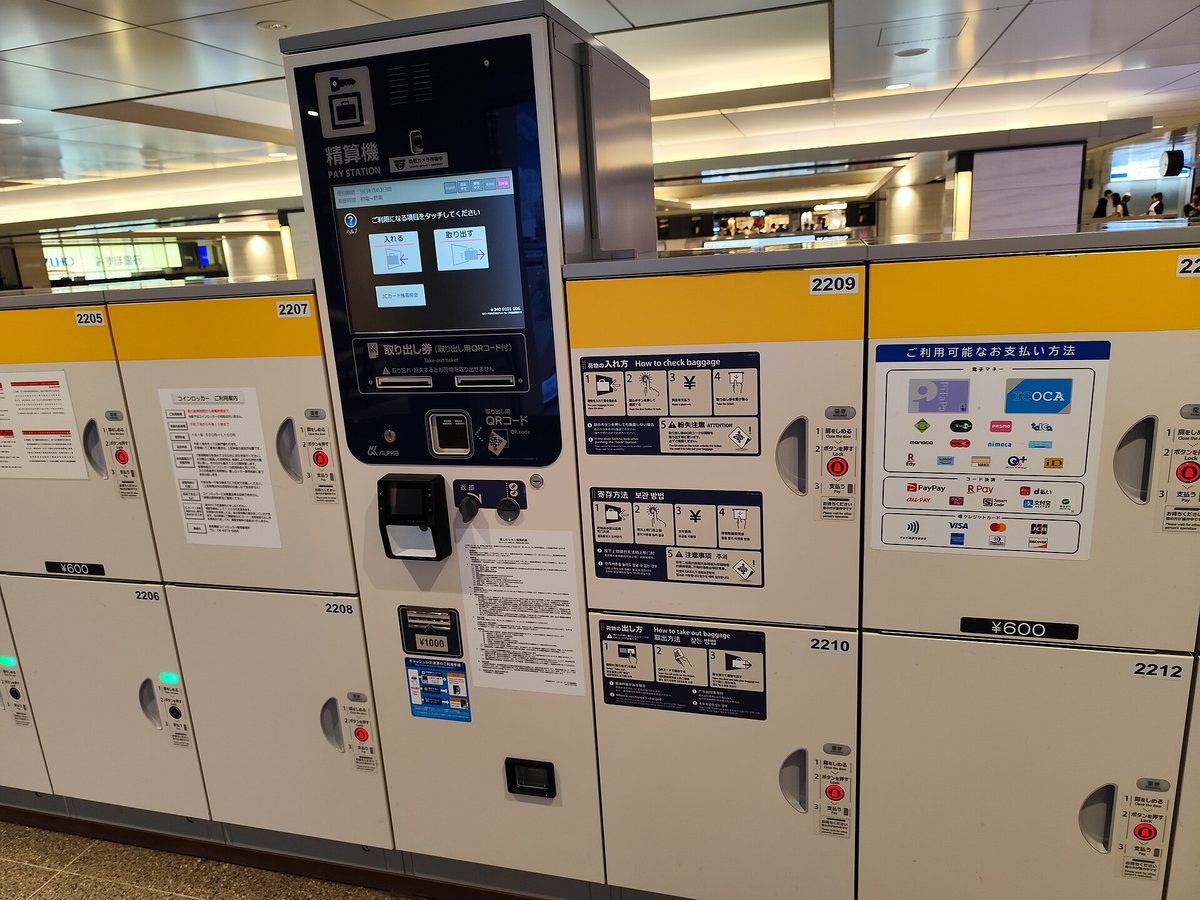
Coin lockers are the quick option when you only need to leave a bag for the afternoon. JR West says all its Shinkansen stations and major stations have them. The catch is size. JR West lists these basic sizes:
- IC cards often work. Many lockers have a central touch screen and take IC cards (Suica, ICOCA and others). JR East says you can use a Welcome Suica card as the key to your locker and to pay for it.
- If the lockers are full, JR West says Kyoto, Shin-Osaka, Osaka, Okayama, Kanazawa and Hiroshima stations have staffed luggage storage. Sagawa and Yamato also run storage counters at some stations, for example 1,000 yen per bag per day at Yamato's Kyoto counters.
- Lockers are for hours, not days. Read the maximum time on the locker before you use it, and for a big suitcase on a travel day, sending it ahead is often easier.
No free locker for your suitcase? You can also leave bags at a shop or hotel near your route: Radical Storage lists luggage storage spots across Tokyo (affiliate link) that you can book online by the day (checked October 17, 2026). Opening hours and conditions differ by location, so check them before you book.
Big suitcases on the Shinkansen
If you do take your suitcase on the train, check its size first. On the Tokaido, Sanyo and Kyushu Shinkansen, a bag whose length, width and height add up to more than 160 cm needs a reserved seat with an oversized baggage area. Our guide to the Japan Rail Pass and Shinkansen tickets explains how to book one. Many travelers find it simpler to send the big case ahead and ride with a day bag. In Kyoto, the city also asks visitors not to take large luggage onto crowded city buses; see our guide to Gion (Kyoto).
A simple plan for a Tokyo, Kyoto and Osaka trip
- Tokyo, the evening before you leave: ask the front desk to send your suitcase to your Kyoto hotel. Keep one night's things in a day bag.
- Travel day: ride the Shinkansen with only your day bag; use a coin locker if you sightsee before check-in.
- Two days before your flight home: send the suitcase from your last hotel to the airport, then collect it at the airport counter on your departure day.
Need help in English? Yamato Transport's English line is 0120-67-9625 (toll-free in Japan) or 03-6834-7503 (+81-3-6834-7503), 8:00 a.m. to 9:00 p.m., every day.
Flying home from Kansai International Airport? Klook's luggage delivery from Osaka and Kyoto hotels to Kansai International Airport (affiliate link) also covers hotel-to-hotel delivery within Osaka and Kyoto, with same-day options (checked October 17, 2026). Send the suitcase ahead, enjoy your last day with free hands, and collect it before your flight.
Last reviewed: October 17, 2026. Prices, counters and cut-off times change; please check the official pages below before you send a bag.
References
- Yamato Transport (official): Airport TA-Q-BIN
- Yamato Transport (official FAQ): Same-day delivery and normal delivery
- Yamato Transport (official FAQ): Sending luggage from one hotel to another
- Yamato Transport (official FAQ): How to use Airport TA-Q-BIN
- Yamato Transport (official): Baggage delivery and storage services in Kyoto
- Sagawa Express (official): SAGAWA Hands-Free Travel, service center in Shinjuku (Tokyo)
- Sagawa Express (official): Delivering to hotel
- JR West (official FAQ): Coin lockers and basic locker sizes
- JR West (official FAQ): When all the coin lockers are occupied
- JR East (official): Welcome Suica