Haneda Airport to Tokyo: Keikyu Line, Tokyo Monorail, Airport Buses and Fixed-Fare Taxis Compared
Haneda Airport is much closer to central Tokyo than Narita Airport: the airport estimates about 15 minutes to Shinagawa Station by train. There are four main ways in: the Keikyu Line to Shinagawa Station and on toward Asakusa Station, the Tokyo Monorail to Hamamatsucho Station, Airport Limousine buses that stop at major stations and hotels, and fixed-fare taxis. This guide compares their times and fares from each company's official pages, so you can pick the one that drops you closest to your hotel.
After a long flight, the hardest part is often the first ticket machine. Knowing which line to look for before you land makes the first hour in Tokyo much easier.
This page may contain affiliate links. If you buy through them, we may earn a commission at no extra cost to you.
- Going to Shinagawa Station or Asakusa Station: the Keikyu Line
- Going to Hamamatsucho Station, or to Tokyo Station and Ueno Station with one change: the Tokyo Monorail
- Going to a hotel that is a bus stop, with big suitcases: the Airport Limousine bus
- A family or group with lots of luggage, or a late arrival: a fixed-fare taxi or a car booked ahead
First: which terminal, and where's the station?
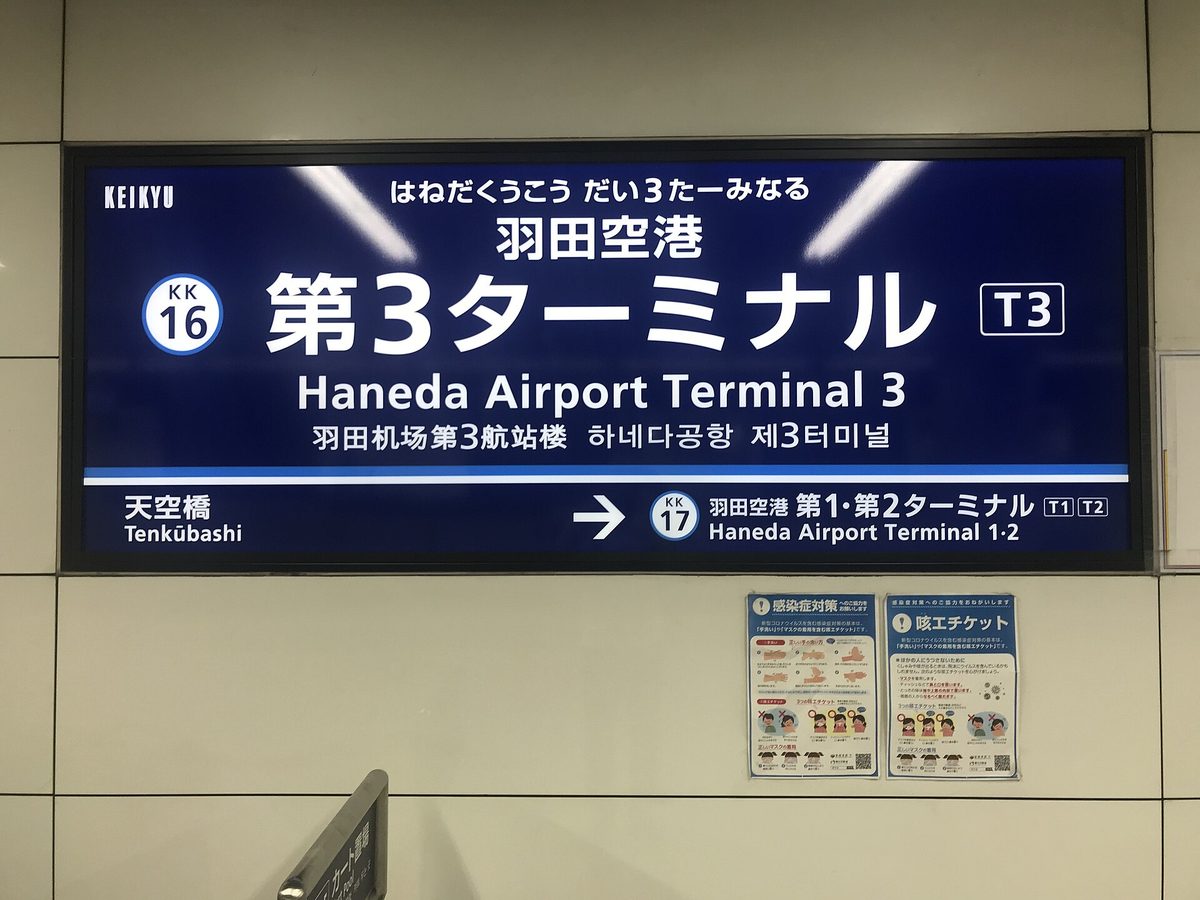
Haneda Airport has three terminals. According to the airport, Terminal 3 handles international flights and Terminal 2 also handles ANA's international flights, so check your ticket for the terminal number. The Keikyu Line has two stations: Haneda Airport Terminal 3 and Haneda Airport Terminal 1·2, which serves both Terminal 1 and Terminal 2. The Tokyo Monorail has a separate station for each terminal. At Terminal 3, the ticket gates for both lines are on the 2nd floor, the arrival lobby (for Keikyu, these are the gates for central Tokyo and Yokohama (Kanagawa); the gates toward Terminals 1 and 2 are on the basement level). At Terminals 1 and 2, both lines leave from the B1 floor.
Keikyu Line: to Shinagawa Station, and direct toward Asakusa Station
The Keikyu Line runs from both of its airport stations to Shinagawa Station, where you can change to JR lines such as the Yamanote Line and the Shinkansen. Keikyu lists 11 minutes from Terminal 3 and 14 minutes from Terminal 1·2. Some trains continue onto the Toei Subway without a change, and Keikyu lists 34 minutes from Terminal 3 to Asakusa Station.
- Fare: Keikyu's fare table shows 330 yen with a paper ticket and 327 yen with an IC card (Suica or PASMO) from either airport station to Shinagawa Station. There's no extra charge for the faster trains.
- Tickets: the ticket machines take cash or a credit card, and an IC card lets you walk straight through the gate.
- Late and early: as of Keikyu's notice dated December 13, 2025, the last train from Terminal 3 toward Shinagawa Station leaves at 0:08 and the first at 5:26, every day.
- KEIKYU Hanetoku Ticket & Tokyo Subway Ticket: a set of a Keikyu ride between the airport and Sengakuji Station and a 24-, 48- or 72-hour pass for all Tokyo Metro and Toei Subway lines (1,600, 2,100 or 2,600 yen for adults). It's sold online only before your trip, through the sites Keikyu lists, and can't be bought at the airport.
Tokyo Monorail: to Hamamatsucho Station, then JR
The Tokyo Monorail runs from all three terminals to Hamamatsucho Station, where you change to JR lines such as the Yamanote Line. Its guide for international arrivals lists 13 minutes to Hamamatsucho and says trains run on average every 5 minutes.
- Fare: 520 yen with a paper ticket or 519 yen with an IC card to Hamamatsucho Station, from any of the three airport stations (child 260 yen, or 259 yen with an IC card).
- Monorail and Yamanote Line Discount Ticket: 590 yen from any Haneda Airport station to any station on the Yamanote Line. The monorail says it's sold on weekends, holidays and other select dates.
- Where to board at Terminal 3: leave the arrival lobby on the 2nd floor, turn left to the monorail gates, then take the escalator up to the platform for Hamamatsucho.
Times to the main areas
Haneda Airport publishes rough train times to the main stations. These include a change of trains where one is needed.
| Station | About | A common way |
|---|---|---|
| Shinagawa Station | 15 min | Keikyu Line, direct |
| Hamamatsucho Station | 20 min | Tokyo Monorail, direct |
| Tokyo Station | 30 min | Monorail, then JR |
| Ueno Station | 40 min | Monorail, then JR |
| Asakusa Station | 40 min | Keikyu Line (some trains direct) |
| Shibuya Station | 45 min | Keikyu Line, then JR |
| Shinjuku Station | 50 min | Keikyu Line, then JR |
Airport Limousine buses: to hotels and the Shinjuku Station area
Airport Limousine buses (Airport Transport Service) run from all three terminals to stations and hotels across Tokyo. If your hotel is one of the stops, you don't have to carry your luggage through train transfers. For example, the route to the Shinjuku Station area (Shinjuku Station, the expressway bus terminal and several hotels) costs 1,400 yen for adults and 700 yen for children, and its timetable includes departures after midnight from Terminal 3. Buses use the expressway, so travel time depends on traffic; check the timetable for your terminal on the official site.
Fixed-fare taxis: by ward, plus tolls
The Tokyo Hire-Taxi Association sets fixed fares from Haneda Airport to most of Tokyo's 23 wards. No reservation is needed: go to the taxi area at your terminal. Expressway tolls are added on top (the fixed fare assumes the Shuto Expressway), and a higher fixed fare applies between 10 p.m. and 5 a.m. A few examples from the chart that took effect on April 20, 2026:
| Ward | Fixed fare | 10 p.m. to 5 a.m. |
|---|---|---|
| Chiyoda (Tokyo), around Tokyo Station | 7,600 yen | 9,000 yen |
| Shibuya (Tokyo), around Shibuya Station | 8,500 yen | 10,000 yen |
| Shinjuku (Tokyo), around Shinjuku Station | 9,000 yen | 10,700 yen |
| Taito (Tokyo), around Ueno Station and Asakusa Station | 9,100 yen | 10,800 yen |
| Sumida (Tokyo), around Tokyo Skytree | 9,100 yen | 10,700 yen |
Some wards, including Minato, Chuo and Shinagawa, aren't on the fixed-fare chart, so the meter is used there. For one person a taxi costs many times the train, but for a family with suitcases, or after the last train, it can be the simplest choice.
Which one fits your trip?
- Staying near Shinagawa Station or Asakusa Station: the Keikyu Line, often without a change.
- Staying near Hamamatsucho Station, Tokyo Station or Ueno Station: the Tokyo Monorail, changing to JR at Hamamatsucho.
- Staying near Shinjuku Station or Shibuya Station: the Keikyu Line and JR via Shinagawa, or the Airport Limousine bus if your hotel is a stop.
- Lots of luggage, small children or a late arrival: a fixed-fare taxi, or a car booked before you fly.
Not sure which area to stay in? Our guide to where to stay in Tokyo compares five areas by airport access. Before you ride, see our guides to cash and IC cards in Japan and Suica on iPhone, since an IC card is the easiest way through the gates. Landing at Narita Airport instead? See Narita Airport to Tokyo. To skip carrying suitcases on trains, see luggage forwarding and coin lockers.
Last reviewed: October 17, 2026. Fares, timetables and routes change. Please check each company's official page before you travel.
References
- Haneda Airport: Train and monorail (English)
- Haneda Airport: Taxi (English)
- Haneda Airport: FAQ, flights and terminals (English)
- Keikyu: Train fares and travel times (English)
- Keikyu: Fare table, paper tickets (Japanese, PDF)
- Keikyu: Fare table, IC cards (Japanese, PDF)
- Keikyu: Buying a ticket (English)
- Keikyu: Late night and early morning (English)
- Keikyu: KEIKYU Hanetoku Ticket & Tokyo Subway Ticket (English)
- Tokyo Monorail: Access from Haneda Airport (English)
- Tokyo Monorail: Fare table (English)
- Tokyo Monorail: Recommended tickets (English)
- Airport Limousine: Haneda Airport to the Shinjuku Station area (English)
- Tokyo Hire-Taxi Association: Taking a taxi from Haneda Airport (English)
- Tokyo Hire-Taxi Association: Fixed fare chart (PDF)