What to Do in an Earthquake in Japan: A Visitor's Step-by-Step
Japan has a lot of earthquakes, and most of them are small. You might feel a gentle sway in your hotel room and notice that nobody around you seems worried. Still, it is worth knowing what to do in the rare case that the shaking is strong, especially if you are near the sea. The good news is that Japan has a nationwide early warning system, and the steps you need are short. This guide puts them in order, from a two-minute setup before your trip to what to do in the first seconds, near the coast, and afterwards. Everything here comes from the Japan Meteorological Agency (JMA), the Japan Tourism Agency and JNTO.
This page may contain affiliate links. If you buy through them, we may earn a commission at no extra cost to you.
- A free app that sends earthquake and tsunami alerts in your language
- What to do in the first seconds, wherever you are
- Why you don't wait for a warning when you are near the sea
- Where to get information and help afterwards
Before you go: two minutes of setup
- Install "Safety tips". This free app was developed under the supervision of the Japan Tourism Agency. It sends push alerts for Earthquake Early Warnings, tsunami warnings and other weather warnings in 15 languages, and includes an evacuation flowchart and phrases to show people around you. Choose your locations in the settings (up to five places in Japan). The support page notes that alerts stop if the location settings haven't been updated for more than one month, unless automatic location setting is on.
- Save the Japan Visitor Hotline: 050-3816-2787, 24 hours, 365 days, in English, Chinese and Korean. It covers natural disasters as well as illness and accidents.
- At check-in, notice where the emergency stairs are on your floor. It takes a few seconds and helps if you ever need to leave quickly.
When the alarm sounds or the ground starts shaking
An Earthquake Early Warning (Kinkyu Jishin Sokuho) is sent to TV, radio and phones as soon as a quake is detected. JMA explains that it can arrive a few seconds to a few tens of seconds before strong shaking, but close to the epicenter the shaking may arrive at the same time as the warning. Phones sound a loud alarm. When you hear it, don't look for more information first. Protect yourself where you are.
JMA's advice, place by place:
JMA also notes that upper floors of a building can shake considerably more than the ground floor. If you are high up in a hotel, expect strong swaying, keep away from things that can fall, and stay where you are until it stops.
Near the sea: don't wait for the warning
This is the one part of the guide to remember even if you forget everything else. JMA's tsunami advice is simple: if you are in a coastal area and you feel strong shaking, or weak shaking that goes on for a long time, evacuate immediately to high ground or a tsunami evacuation building. Don't wait for an official warning, because a tsunami can arrive before warnings are issued if the quake is close to the coast.
- Go on foot, and keep moving to the highest ground you can reach. JMA warns that tsunami heights can exceed estimates.
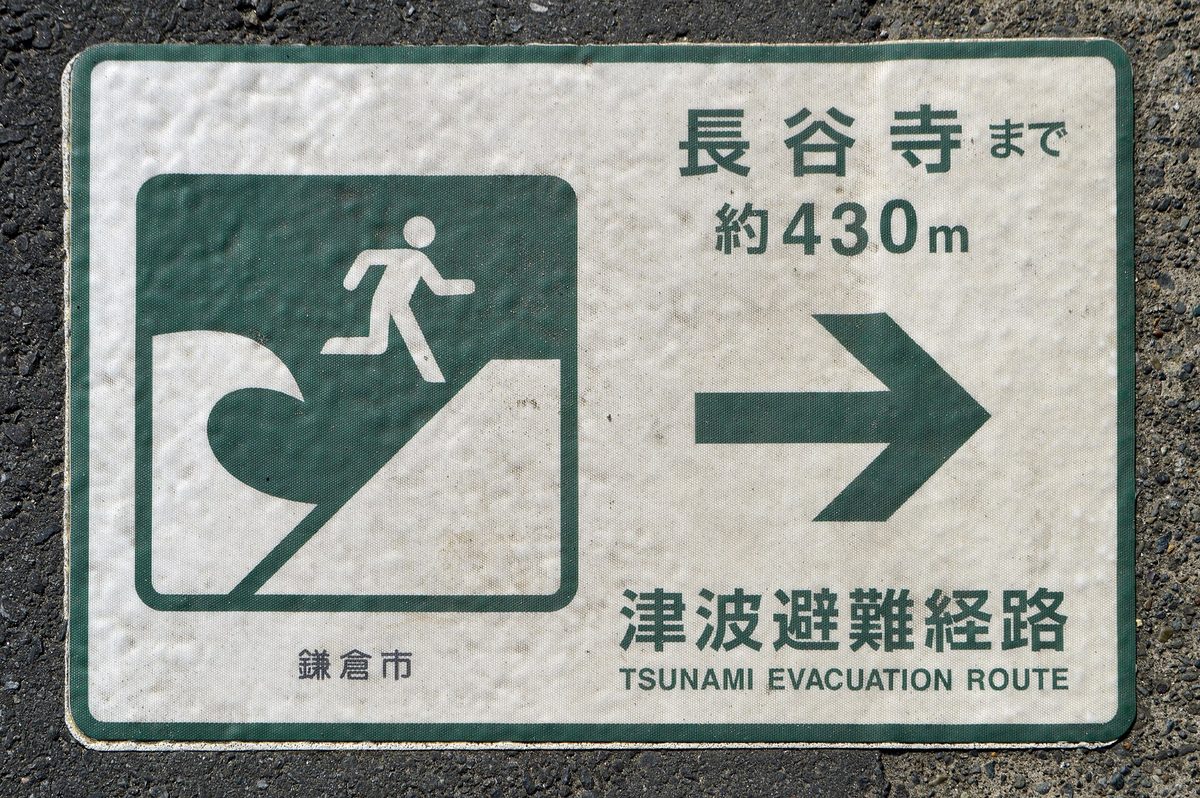
- Look for the signs. Tsunami evacuation signs point to evacuation areas and buildings, and some are set into the road surface.
- Know the flag. Since summer 2020, beaches use a red and white checkered "tsunami flag" to show that a tsunami warning has been issued, so that swimmers and people who can't hear sirens get the message. If you see it, leave the water and the beach right away.
- Stay up there. Tsunami waves hit repeatedly. Don't go back to the coast until the warnings have been cleared.
For reference, JMA issues a Major Tsunami Warning when waves are expected to be higher than 3 meters, and a Tsunami Warning for waves of up to 3 meters. Both mean the same thing for you: leave coastal and river areas now. For beach safety in general, see our guide to swimming safely in Okinawa.
After the shaking stops
- Check yourself and the people with you. If someone is hurt, call 119. Our guide to emergency numbers in Japan explains what to say.
- Follow staff instructions. In hotels, stations and stores, JMA's advice is to follow the staff and not rush to the exit.
- Get reliable information. Use the Safety tips app, or the Japan Visitor Hotline at 050-3816-2787. JNTO's Staying Safe in Japan page links to more resources.
- If mobile data stops working, look for the free Wi-Fi network "00000JAPAN". Under a scheme described by the Ministry of Internal Affairs and Communications, public Wi-Fi operators open it free of charge in a disaster. It has no password, so avoid entering passwords or card details while using it.
- Stay alert for more shaking. Large earthquakes can be followed by more strong ones. When the government issues a special advisory after a big quake, it asks people to stay ready to evacuate for about a week while continuing daily life.
What the numbers on the news mean
Japanese news reports earthquakes on JMA's seismic intensity scale (shindo), which describes how strongly the ground shook at each place, not the size of the quake itself. It runs from 0 to 7. At 3, most people indoors feel it. At 4, JMA says most people are startled. At "5 lower", many people feel the need to hold onto something, and dishes and items on shelves may fall. Two places in the same city can record different numbers.
Your two-minute checklist
- Install Safety tips and set your locations.
- Save 050-3816-2787 (Japan Visitor Hotline).
- Find the emergency stairs in your hotel.
- Alarm or shaking: protect your head first, then think.
- Near the sea and the ground shakes: go up, on foot, right away.
Knowing these few steps ahead of time means you won't have to work them out in a frightening moment.
Last reviewed: October 4, 2026. Please also follow instructions from local authorities and staff on the spot, and check the official pages below.
References
- Japan Meteorological Agency: Earthquake Early Warning, Dos & Don'ts (PDF)
- Japan Meteorological Agency: Earthquake Early Warnings
- Japan Meteorological Agency: Tsunami Warnings/Advisories and Tsunami Information
- Japan Meteorological Agency: Evacuate immediately! (tsunami leaflet, PDF)
- Japan Meteorological Agency: Tsunami flags
- Japan Meteorological Agency: Tables explaining the JMA Seismic Intensity Scale
- JNTO: Safety tips, the push-enabled information alert app for foreign tourists
- Safety tips support page (location settings)
- Ministry of Internal Affairs and Communications: Free public Wi-Fi in disasters, 00000JAPAN (Japanese)
- Cabinet Office (Disaster Management): Subsequent earthquake advisory leaflet (PDF)
- JNTO: Japan Visitor Hotline
- JNTO: Staying Safe in Japan