Japan Power Plugs and Voltage: Plug Type, 100 Volts, 50/60 Hz, and Whether You Need an Adapter or a Transformer
Japan's sockets take a plug with two flat pins, and the electricity is 100 volts. For most travelers that means one small check at home: read the label on each charger and appliance, and pack a plug adapter if your plugs are a different shape. Phones and laptops usually need nothing more. Hair dryers and other heating appliances are the ones that cause trouble.
This guide explains the plug shape, the 100 volts and the east-west frequency difference, how to read a label, and what to do about a hair dryer.
- JNTO (Japan's national tourism organization) says power outlets in Japan use Type A plugs: two flat, parallel pins.
- The voltage is 100 volts everywhere in Japan. The frequency is 50 hertz in eastern Japan and 60 hertz in western Japan.
- If a label says INPUT 100-240V, the item works in Japan with only a plug adapter (if the plug shape is different).
- An item made only for 220-240 volts needs a transformer. For a hair dryer that transformer is big and heavy, so use the hotel's dryer if there is one.
The plug shape: Type A
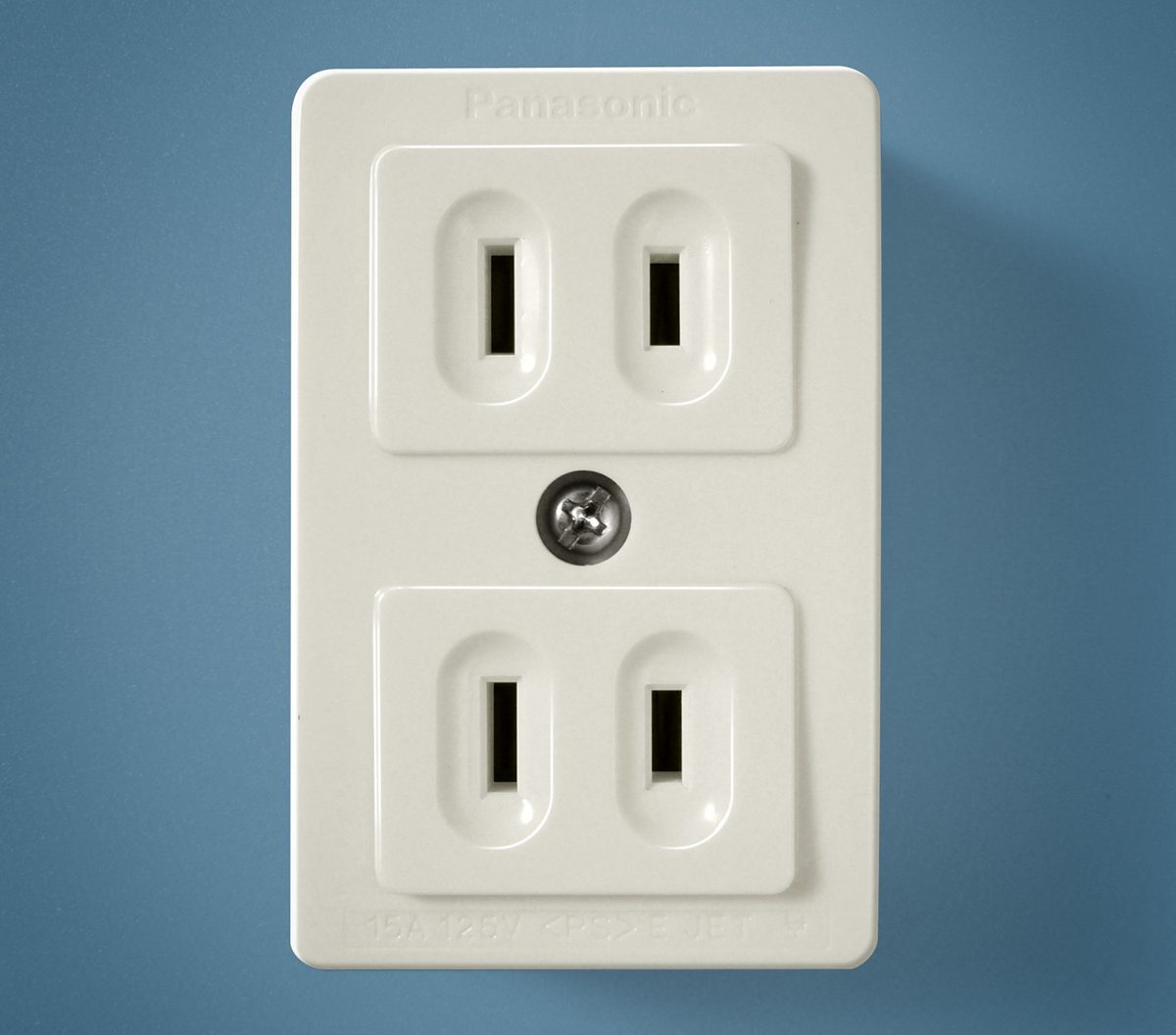
JNTO's FAQ says Japan's power outlets use Type A plugs, and that travelers from overseas may need a plug adapter. A Type A plug has two flat pins side by side and no third pin. A typical wall socket in a hotel room has two slots per outlet, like the one in the photo above.
- Your plug has two flat parallel pins: it should go straight in.
- Your plug has a third, round pin (an earth or ground pin): it won't fit a two-slot socket. Japanese sockets with a third hole for an earth pin do exist, but Panasonic, a major Japanese maker, explains that they are meant for places such as kitchens and washrooms and for appliances such as refrigerators, microwaves and washing machines. Don't count on one in your room, and bring an adapter.
- Your plug has round pins, or three flat pins in a triangle or a T shape: you need a plug adapter that turns it into a Type A plug.
A plug adapter changes only the shape of the plug. It doesn't change the voltage.
100 volts, and 50 or 60 hertz
JNTO says the voltage used throughout Japan is uniformly 100 volts, AC. There are two frequencies: 50 hertz in eastern Japan and 60 hertz in western Japan, including Nagoya (Aichi), Kyoto and Osaka. You don't need to know where the line is. What matters is what your devices accept, and that is printed on their labels.
How to read the label on a charger or appliance
Look for the line that starts with INPUT on the charger, the power brick or the appliance itself. SMBC Trust Bank's travel guide explains that a charger or product printed with "INPUT: 100-240V" is made for use around the world and doesn't need a transformer. JNTO says the same of dual-voltage hair dryers, travel irons and shavers: they should work anywhere in Japan.
- 100-240V (or 100-250V): works in Japan. Only the plug shape may need an adapter.
- Only 220-240V, or only 230V: it isn't made for 100 volts. You need a transformer, or a different appliance.
- A range that doesn't include 100, such as 110-120V: check the maker's page before you rely on it at 100 volts.
- The frequency: the same line usually shows the hertz, such as 50/60Hz. If it lists both, the east-west difference doesn't matter. If it lists only one, check with the maker before using it in the other half of Japan.
When you need a transformer, and why a hair dryer is the hard case
A transformer changes the voltage. To run an appliance made for 220-240 volts in Japan, you need one that raises Japan's 100 volts to that level. Kashimura, a Japanese maker of travel transformers, sells large models that convert between 100 volts and 220-240 volts in both directions. Its notes say that for appliances that make heat, such as irons, hot plates, hair dryers and rice cookers, you should choose a transformer rated at about 2 to 3 times the appliance's power consumption.
That adds up fast. For a hair dryer of 1,200 watts, 2 to 3 times is 2,400 to 3,600. Kashimura's 3000VA model weighs about 8.4 kg, and its 1500VA model about 5.8 kg. That is a lot to carry for a hair dryer.
- Check your hotel first. Some hotels have a dryer in the room. For example, Toyoko Inn's room guide lists a hair dryer installed on the wall near the desk. Check your own hotel's room page.
- Ask about borrowing a transformer. Some hotels lend transformers to guests. Once your stay is booked, ask the hotel before you pack one.
- Bring a dual-voltage travel dryer, one whose label says 100-240V.
- Don't plug a 220-240V-only appliance straight into a Japanese socket with only a plug adapter. The adapter makes it fit, but the voltage is still 100 volts, and the appliance isn't made for it.
JNTO notes that conversion plugs and transformers are relatively easy to find in cities: in electronics districts such as Tokyo's Akihabara and Osaka's Nipponbashi, and at large electronics stores such as Yodobashi Camera and Bic Camera. If you forget an adapter, that is where to look.
USB sockets in hotels, and charging on the go
Some hotel rooms have a USB socket by the bed. Toyoko Inn's room guide, for example, lists a reading light and USB power supply next to the bed. Not every hotel has one, and the type of USB connector varies, so pack your own charger and cable as well. A charger with two or more ports means fewer adapters.
Out for the day, a phone battery runs down fast with maps and translation apps. You can rent a power bank at many stations and convenience stores: see renting a power bank in Japan. Power banks go in your carry-on bag, never in checked baggage; the rules are in the same guide.
Before you pack
- Read the INPUT line on every charger and appliance.
- Pack a plug adapter to Type A if any plug has round pins, a third pin or a different shape.
- Leave single-voltage heating appliances at home, or plan a transformer.
- Check whether your hotel room has a hair dryer, and ask the hotel whether you can borrow a transformer.
- Bring your charging cables; a USB socket in the room is a bonus, not a given.
The rest of the preparation, from medicines to mobile data, is in our Japan trip checklist. For what goes in the suitcase, see our Japan packing list, and for staying online, eSIM or pocket Wi-Fi.
Last reviewed: October 23, 2026. Hotel equipment and product details change. Please check your hotel's page, your device's label and the official pages below.
Official sources (checked October 2026)
- JNTO: Plugs and electricity in Japan (English)
- JNTO: FAQ, "What is the voltage and plug type used in Japan?" (English)
- Panasonic: sockets with an earth pin hole and earth terminal (Japanese)
- SMBC Trust Bank PRESTIA, GLOBAL COMPASS: do you need a transformer when traveling? (Japanese)
- Kashimura: large transformers for 100V and 220-240V, June 26, 2026 (Japanese)
- Toyoko Inn: rooms and services (English)