Japanese Mythology for Travelers: The Kojiki, Amaterasu's Cave, Susanoo's Serpent and the Places You Can Visit
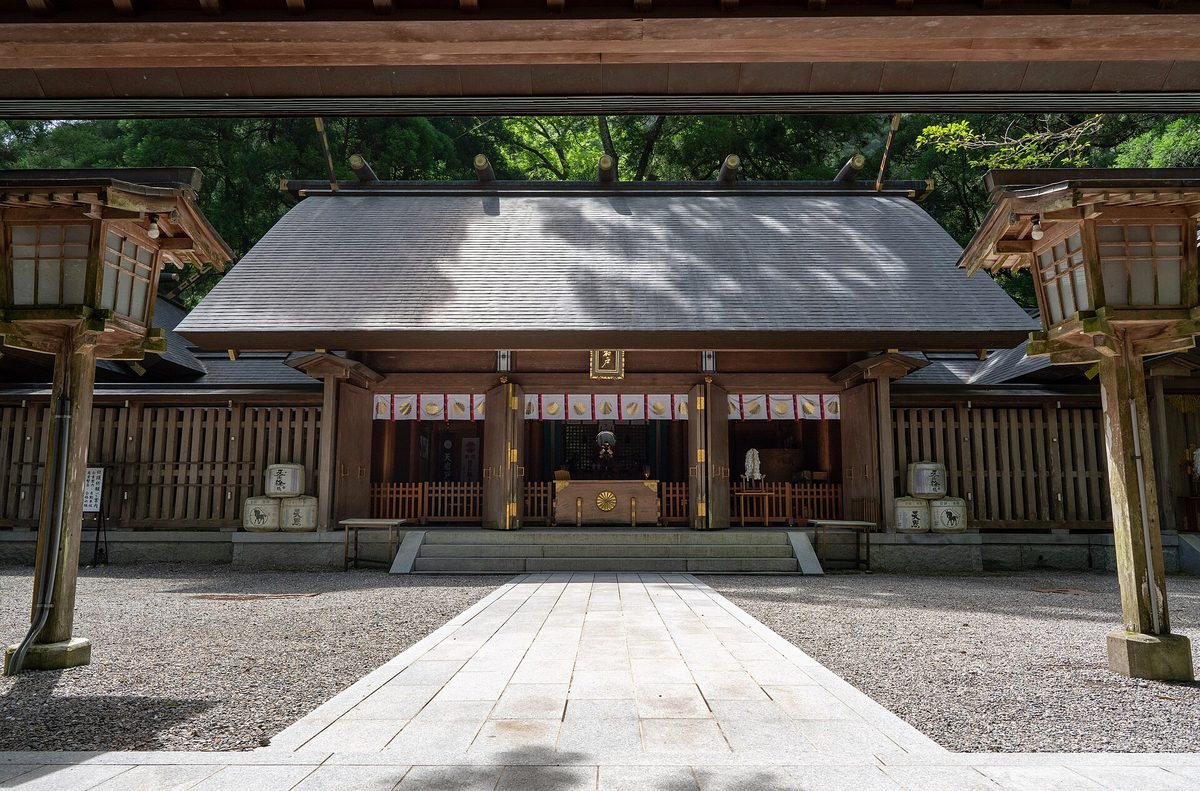
Walk into almost any Japanese shrine and you are stepping into a story. The kami (the Shinto gods) honored at Ise (Mie), Izumo (Shimane) and Takachiho (Miyazaki) are the same kami who appear in Japan's oldest books, the Kojiki and the Nihon Shoki. This column tells the best-known myths in plain English, from the birth of the islands to the grandson of the sun goddess coming down to earth, and shows where you can still visit them. The stories are retold as these books tell them, checked against Kokugakuin University's annotated Kojiki, the Association of Shinto Shrines (Jinja Honcho) and the shrines' own pages. They are myths, not history.
- The short answer: what are the Kojiki and the Nihon Shoki?
- Izanagi and Izanami make the islands, and the land of the dead
- Amaterasu hides in a cave and the world goes dark
- Susanoo slays the eight-headed serpent
- Okuninushi, the white hare of Inaba and the handing over of the land
- Ninigi comes down to Takachiho
- Where the myths live on today, and how to visit
The short answer
The Kojiki (Records of Ancient Matters) and the Nihon Shoki (Chronicles of Japan) are Japan's oldest surviving books of myth and history. Izumo Taisha dates them to 712 and 720. Kokugakuin University's Kojiki project calls the Kojiki the oldest surviving history book in Japan, in three volumes; its first volume is the age of the kami. The Nihon Shoki was finished at about the same time and records many variant versions of the stories.
Many shrines in Japan honor kami from these myths. That is why the same few names, like Amaterasu-Omikami and Okuninushi-no-Okami, come up again and again on shrine signboards.
Two books, two ways of telling it
The two books mostly tell the same myths, but not word for word. Kokugakuin's project describes the Kojiki as one continuous story, while the Nihon Shoki gives a main text and then lists other versions, each introduced as "one book says." The names of the kami are also written with different Chinese characters: the Kojiki's 須佐之男命 is 素戔嗚尊 in the Nihon Shoki, and the Kojiki's 天照大御神 is 天照大神. In English, both are usually spelled the same way, Susanoo and Amaterasu. Where the stories differ in a way that matters, this column says so.
Izanagi and Izanami: making the islands, and the land of the dead
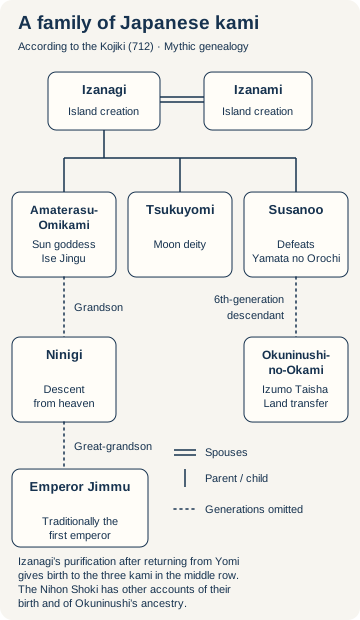
In the Kojiki, two kami, Izanagi (also read Izanaki) and Izanami, are given a jeweled spear. They stir the sea below heaven with it, and the brine that drips from the tip piles up into the first island, Onogoro. There they marry and give birth to the islands of Japan. Because they bore eight islands first, the Kojiki says, the land was called Oyashima, "the Great Eight Islands." This story is often called kuniumi, the birth of the land.
Then comes a sad turn. Izanami gives birth to the kami of fire, is burned, and dies. Izanagi follows her to Yomi, the land of the dead, and begs her to come back. She has already eaten the food of Yomi, but agrees to ask the kami there, and tells him not to look at her. He waits, grows impatient, lights a tooth of his comb and looks. He sees her body rotting, with thunder kami on it, and runs. At the slope between the worlds, Yomotsu Hirasaka, he blocks the way with a huge boulder. Izanami swears she will kill a thousand of his people every day; Izanagi answers that he will build fifteen hundred birthing huts a day. The Kojiki explains this is why a thousand people die and fifteen hundred are born each day, and it says the slope is the Iya slope in Izumo. In the Nihon Shoki, details of this story appear in the other versions it lists.
Back home, Izanagi washes off the pollution of Yomi in a river. When he washes his left eye, Amaterasu-Omikami, the sun goddess, is born; from his right eye comes Tsukuyomi, the moon kami; and from his nose, Susanoo. Purification by washing is still part of every shrine visit today: you rinse your hands and mouth at the water basin before you pray.
Amaterasu hides in the cave and the world goes dark
Susanoo runs wild in heaven. In the Kojiki, he wrecks Amaterasu's rice fields, then breaks a hole in the roof of the sacred weaving hall and drops in a flayed horse; a weaving maiden is so shocked that she is fatally hurt. Amaterasu is frightened, goes into the Heavenly Rock Cave (Ama-no-Iwato) and shuts the door. Heaven and earth go completely dark. In the main text of the Nihon Shoki, it is Amaterasu herself who is hurt.
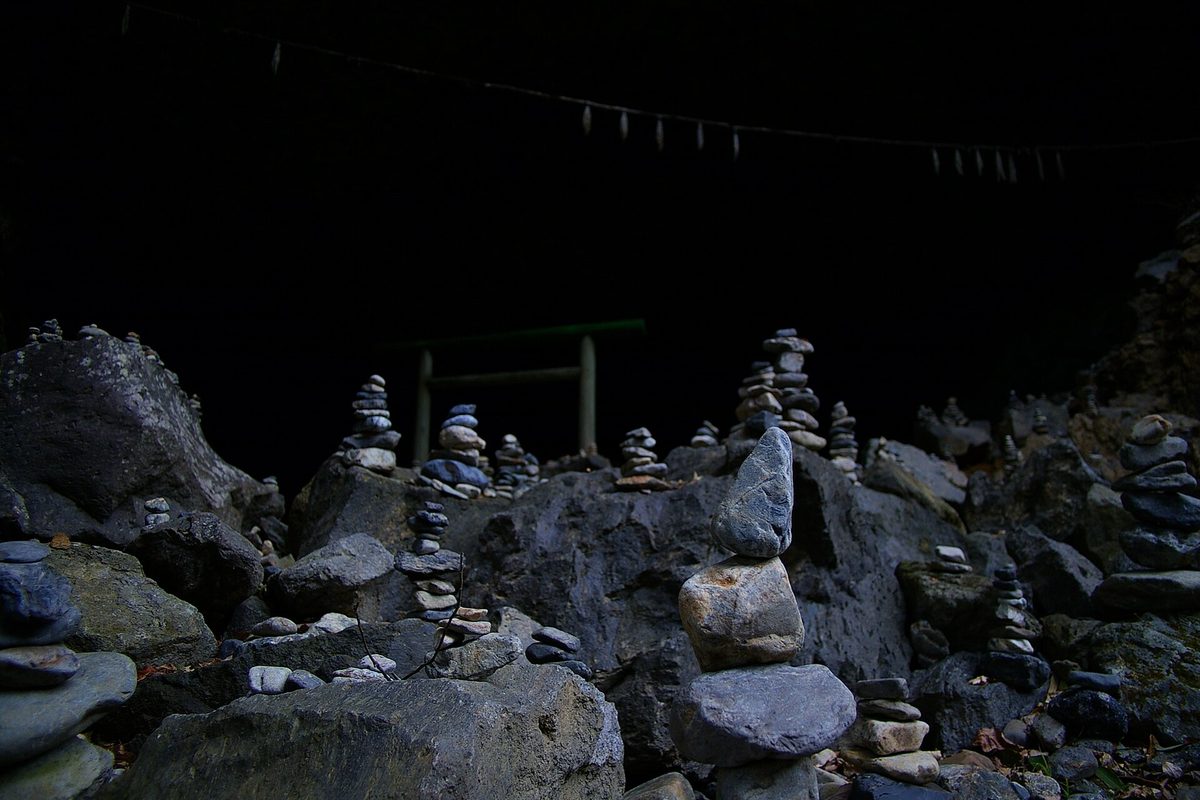
The many kami (the "eight million kami") gather by the river of heaven to make a plan. They hang a mirror and jewels on a sacred tree. The goddess Ame-no-Uzume dances on an upturned tub, and the kami burst out laughing. Curious, Amaterasu opens the door a little to look, and the strong kami Ame-no-Tajikarao, hiding beside the door, takes her hand and pulls her out. Light returns to the world.
In Takachiho (Miyazaki), Amanoiwato Shrine honors a cave that it says is where Amaterasu hid; the cave itself is the shrine's sacred body. A short walk away is Amano Yasukawara, a large cave by the river that the shrine describes as the place where the kami gathered.
Susanoo and the eight-headed serpent
For his wild behavior, Susanoo is driven out of heaven. In the Kojiki, he comes down beside the upper Hi River in Izumo and finds an old couple weeping over their daughter, Kushinadahime. A serpent called Yamata no Orochi, with eight heads and eight tails and eyes as red as winter cherries, has eaten their other daughters, one each year, and is coming for her.
Susanoo has strong sake brewed and set out in vats behind eight gates. The serpent drinks, falls asleep, and Susanoo cuts it to pieces; the river runs red. Inside one tail he finds a great sword, and he presents it to Amaterasu. The Kojiki calls it Kusanagi-no-Tachi. In the main text of the Nihon Shoki it is Kusanagi-no-Tsurugi, and a note says it was first named Ame-no-Murakumo. Susanoo then marries Kushinadahime and builds a palace in Izumo.
Okuninushi, the white hare and handing over the land
Okuninushi-no-Okami is the main kami of Izumo Taisha in Izumo (Shimane). The shrine calls him the kami who built the land, and today he is widely loved as a kami of en-musubi, good connections between people, not only in love. In the Kojiki he is a later descendant of Susanoo; in the main text of the Nihon Shoki, he is Susanoo's son.
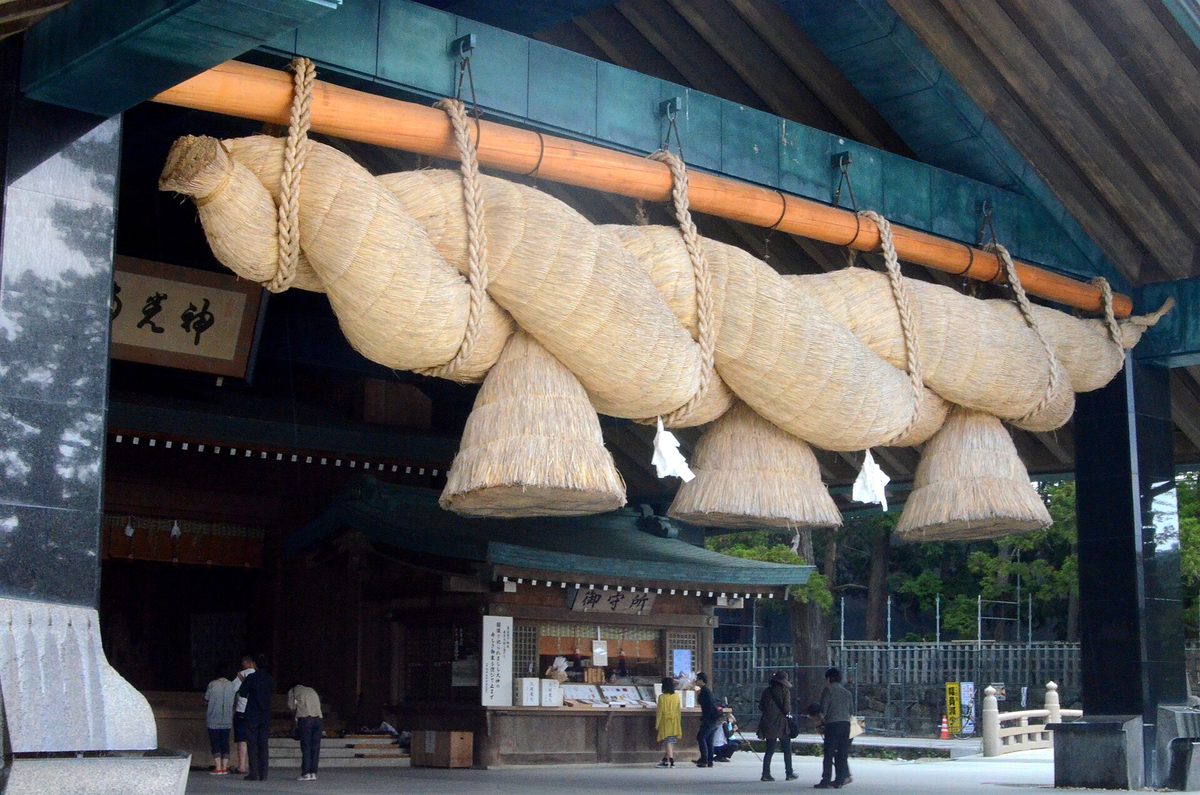
His most famous story is the white hare of Inaba, which Izumo Taisha notes is told in the Kojiki. Okuninushi's many brothers set off to court Princess Yakami of Inaba, making him carry their bags. On the way they find a hare that has lost its fur: it had tricked the wani (sharks, in the shrine's retelling) into lining up so it could hop across the sea, then boasted about it, and they stripped it bare. The brothers tell it to bathe in seawater and dry in the wind, which makes it worse. Okuninushi, coming last, tells it to wash in fresh water and lie on cattail flowers, and the hare is healed. The princess chooses Okuninushi.
Later comes the handing over of the land (kuniyuzuri). Messengers from heaven, led in the Kojiki by Takemikazuchi, ask Okuninushi to hand the land to Amaterasu's descendants. One of his sons agrees; the other, Takeminakata, loses a contest of strength and flees to Suwa, which Jinja Honcho explains is why Suwa shrines honor him. Okuninushi agrees, asking for a great palace with pillars set deep in the bedrock. Izumo Taisha says that palace is the origin of the shrine.
Ninigi comes down to Takachiho
Now Amaterasu sends her grandson, Ninigi, to rule the land below. Jinja Honcho retells how she gives him the Three Sacred Treasures: the mirror (Yata-no-Kagami), the jewel (Yasakani-no-Magatama) and the sword (Kusanagi-no-Tsurugi). In the Kojiki, she tells him to worship the mirror as if it were her own spirit. Ninigi pushes through the layered clouds and comes down on the peak of Kujifuru at Takachiho in Himuka (Hyuga). This is tenson korin, the descent of the heavenly grandson.
Exactly where he landed is told in more than one way, and two places in southern Kyushu are linked to it. The Takachiho Town Tourism Association points to Kushifuru Shrine in Takachiho (Miyazaki), on the peak it identifies with the Kojiki's Kujifuru. Kagoshima Prefecture describes Kirishima Jingu in Kirishima (Kagoshima), whose main kami is Ninigi, said to have come down on Mount Takachiho-no-mine. The Nihon Shoki's main text names "Takachiho peak in So, Hyuga."
Where the myths live on today
Many shrines honor a kami from these stories, so each shrine has its own kami. Jinja Honcho describes a shrine as a place that enshrines kami said to number in the "eight million," and the local shrine's kami as the guardian of that area. A few links between the myths and places you can visit:
- Ise Jingu, Ise (Mie): the Inner Shrine honors Amaterasu-Omikami, whom Ise Jingu calls the ancestral kami of the Imperial family, enshrined there about 2,000 years ago. Its Holy Mirror is the symbol of Amaterasu. Shinmei shrines across Japan also honor her.
- Izumo Taisha, Izumo (Shimane): Okuninushi-no-Okami. Rabbit statues all over the grounds recall the white hare.
- Amanoiwato Shrine, Takachiho (Miyazaki): Amaterasu and the cave story.
- Atsuta Jingu, Nagoya (Aichi): Atsuta Jingu says it began with the enshrining of the Kusanagi sword, one of the Three Sacred Treasures.
- Kirishima Jingu, Kirishima (Kagoshima): Ninigi.
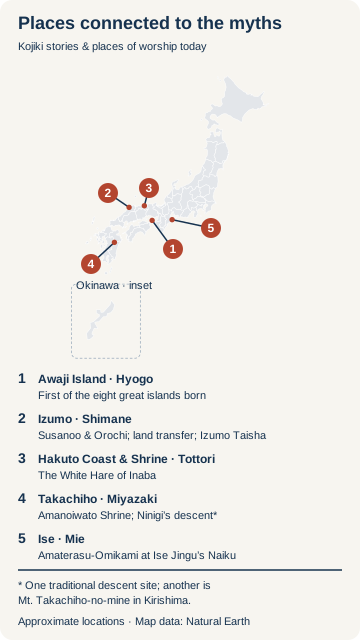
The myths also explain small things you will see. Amanoiwato Shrine, for example, says the bells used in kagura (sacred dance) trace back to the branch Ame-no-Uzume held when she danced in front of the cave. Before you pray, read the signboard near the entrance to learn which kami the shrine honors; our guide to shrines and temples explains how to pray.
If you visit the places of the myths
- Ise Jingu: the Inner Shrine is Amaterasu's. Our guide to visiting Ise Jingu explains which shrine to visit first.
- Izumo Taisha: the shrine's own way to pray is two bows, four claps and one bow. In the 10th month of the old lunar calendar, the shrine says, kami from all over Japan gather here, which is why that month is called Kamiarizuki ("the month with kami") in Izumo. In 2026 the Kamiarisai festival runs from the evening of November 18 to the evening of November 25.
- Amanoiwato Shrine: you cannot walk into the cave. The shrine says a priest leads visitors to a viewing spot behind the West Shrine's hall; the tour takes 10 to 15 minutes and there is no fee. Gather at the rest area before the start time. The path down to Amano Yasukawara has steps and no lights, so go in daylight.
- Takachiho Kagura: the cave story is danced every night at Takachiho Shrine from 8 p.m. to 9 p.m., four dances including Tajikarao's and Uzume's. The tourism association takes online bookings from 30 days before; there are no shows on December 31, January 1, or November 22 and 23 (the yearly kagura festival). Photos are allowed without flash.
- Atsuta Jingu: see our guide to Atsuta Jingu in Nagoya (Aichi).
You don't need to know the myths to visit a shrine, but knowing even one story makes the visit richer: standing near the cave at Takachiho, you know why a dancer and a strong kami appear in the night kagura.
Last reviewed: October 18, 2026. The myths are retold here as the Kojiki and the Nihon Shoki tell them; they are stories, not history. Shrine hours, tours and festivals can change; check the official pages below before you go.
References
- Kokugakuin University, Kojiki project: About the Kojiki (Japanese)
- Kokugakuin University: Kojiki viewer, making the land firm (Japanese, with English)
- Kokugakuin University: Kojiki viewer, the land of Yomi (Japanese)
- Kokugakuin University: Kojiki viewer, the Heavenly Rock Cave (Japanese)
- Kokugakuin University: Kojiki viewer, the eight-headed serpent (Japanese)
- Kokugakuin University: Kojiki viewer, the descent of the heavenly grandson (Japanese)
- Jinja Honcho (Association of Shinto Shrines): Shinto and shrines (Japanese)
- Jinja Honcho: Myths, the descent of the heavenly grandson (Japanese)
- Jinja Honcho: Shrines around Japan (Japanese)
- Ise Jingu: About Jingu (English)
- Izumo Taisha: Izumo Taisha and Okuninushi-no-Okami (Japanese)
- Izumo Taisha: Izumo Taisha and its rabbits (Japanese)
- Izumo Taisha: FAQ (Japanese)
- Izumo Taisha: Kamiarisai 2026 (Japanese)
- Amanoiwato Shrine (official, Japanese)
- Amanoiwato Shrine: Visiting the shrine (Japanese)
- Takachiho Town Tourism Association: Takachiho's myths (Japanese)
- Takachiho Town Tourism Association: Takachiho Kagura (Japanese)
- Kagoshima Prefecture: Kirishima Jingu, national treasure (Japanese, PDF)
- Atsuta Jingu: About Atsuta Jingu (Japanese)