Coming of Age Day in Japan (January 11, 2027): Why Young People Wear Kimono
This page contains affiliate links.
Quick answer
- Coming of Age Day is a national holiday on the second Monday of January: Monday, January 11, 2027.
- Towns hold ceremonies for young residents; many young women wear furisode, and young men wear suits or hakama.
- Japan's age of adulthood became 18 in 2022, but many towns still celebrate at 20; ceremonies are for residents, so watch from outside and ask before taking photos.
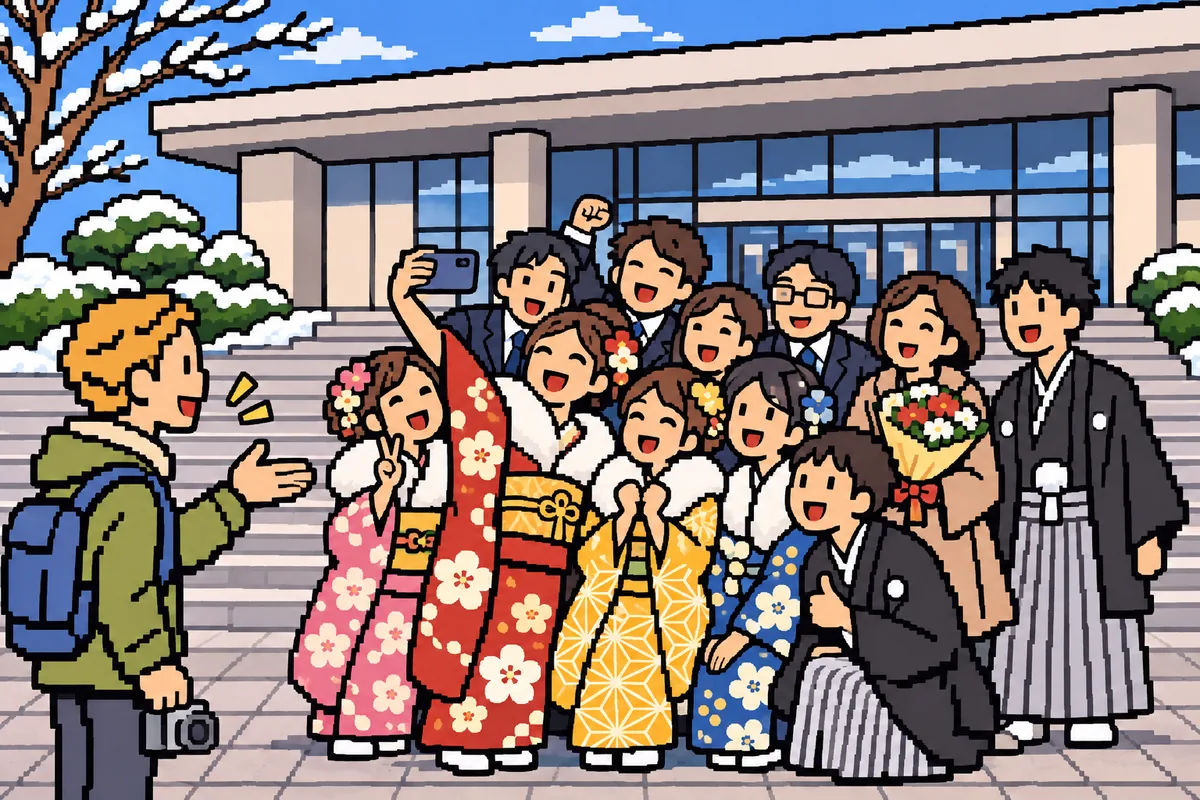
If you see groups of young women in bright, long-sleeved kimono and young men in suits or hakama in January, you are probably seeing Coming of Age Day (Seijin no Hi), a national holiday on the second Monday of January. In 2027 it falls on Monday, January 11. Towns and cities hold ceremonies for young people turning adult, and many dress up for the day.
It can be confusing to arrive in the middle of a celebration you don't know about. Here is what the day means, why most ceremonies are still for 20-year-olds, where you might see it and how to be a polite onlooker.
- 2027 date: Monday, January 11, so Saturday 9 to Monday 11 is a three-day weekend
- Japan's age of adulthood became 18 on April 1, 2022, but many towns still celebrate at 20
- Ceremonies are for local residents of that age; most are not open to visitors
- You'll see kimono and suits around ceremony halls, stations and shrines on the holiday weekend
- Ask before you take a photo of someone
What the holiday is
Japan's law on national holidays describes Coming of Age Day as a day "to celebrate and encourage young people who have become aware that they are adults and are trying to make their own way in life." It is held on the second Monday of January, and the Cabinet Office lists it for January 11 in 2027.
According to Nippon.com, many local governments hold ceremonies to honor young people reaching adulthood, and some areas with heavy snow hold theirs in May or August instead.
Why 20, when adulthood starts at 18?
Japan lowered its age of adulthood from 20 to 18 on April 1, 2022. At 18, people can sign contracts such as a phone plan or a flat without a parent's consent. But the Ministry of Justice points out that drinking, smoking and buying tickets for horse, bicycle, motorboat and auto racing still start at 20.
Nippon.com notes that many towns still hold their ceremonies for 20-year-olds, in line with long-standing custom. Yokohama (Kanagawa), for example, calls its event a gathering to celebrate twenty-year-old residents; the 2027 one is for residents born between April 2, 2006 and April 1, 2007.
What they wear, and why
Nippon.com says people attend in formal clothes, such as suits or traditional kimono. The bright kimono with very long sleeves that many young women wear is called a furisode; the name means "swinging sleeves". Some young men wear hakama, wide pleated trousers worn over a kimono, but suits are common.
So if you see someone in full kimono at a station on the morning of the holiday, they are most likely on their way to their own ceremony.
Where you might see it
- Near ceremony halls, arenas and town halls on the morning and early afternoon of the ceremony.
- At stations and on trains nearby, as groups travel to and from the ceremony.
- At shrines and photo spots, where families take pictures.
The ceremonies themselves are for residents. The city's ceremony on January 11, 2027 is at Yokohama Arena, in two sessions (10:30 and 14:30) for more than 35,000 eligible residents, and the city says it turns away anyone who is not eligible, apart from carers who must accompany a participant. Please don't try to walk in; watch from public spaces outside.
In Kyoto, the archery event at Sanjusangendo temple, held on the second or third Sunday of January, is closely tied to Coming of Age Day: archers from across Japan take part in kimono and hakama, and those turning 20 see it as a rite of passage. In 2027 that means January 10 or 17; check the temple's announcement for the exact date.
How to be a polite onlooker
- Ask before you take a photo, and accept a no. In Japanese: "Shashin o totte mo ii desu ka?" (May I take a photo?). A smile and pointing at your camera also works.
- Don't block entrances or walkways near ceremony venues; families are often on a tight schedule.
- Don't touch anyone's kimono or hair, even to admire it.
- Congratulate them if you like. "Omedetou gozaimasu" (congratulations) is always welcome.
Two things that trip people up:
- Expecting Monday to be a normal day. January 11, 2027 is a national holiday, and some sights change their hours or close, so check before you go.
- Leaving a kimono rental to the last minute on a holiday weekend. Popular shops can fill up, so book once your date is set and confirm the return time.
Planning around the holiday
Because the holiday makes a three-day weekend, check the opening days of museums and sights before you go, and see what January is like in our month-by-month guide. If you visit a shrine that weekend, our guide to shrine and temple etiquette covers the basics. Renting a kimono in Kyoto is explained step by step in kimono rental in Kyoto.
Quick checklist
- Coming of Age Day 2027 is Monday, January 11, a national holiday.
- Ceremonies are for local residents; watch from outside.
- Ask before photographing anyone in kimono.
- Check opening days of sights over the three-day weekend.
- Want to wear kimono yourself? Book your rental early.
Last reviewed: November 23, 2026. Ceremony dates and rules are set by each town; check the official page of the town or event.
References
- Cabinet Office: National holidays, including 2027 (Japanese)
- Ministry of Justice: The age of adulthood is lowered to 18 (Japanese)
- Yokohama City (Kanagawa): Ceremony for twenty-year-old residents, January 11, 2027 (Japanese, updated September 1, 2026)
- Japan Tourism Agency: Sanjusangendo's annual observances (English)
- Nippon.com: Coming of Age Day (English, January 10, 2026)