What Does Gensen Kakenagashi Mean? Free-Flowing Onsen vs Recirculated Baths, and How to Check the Sign
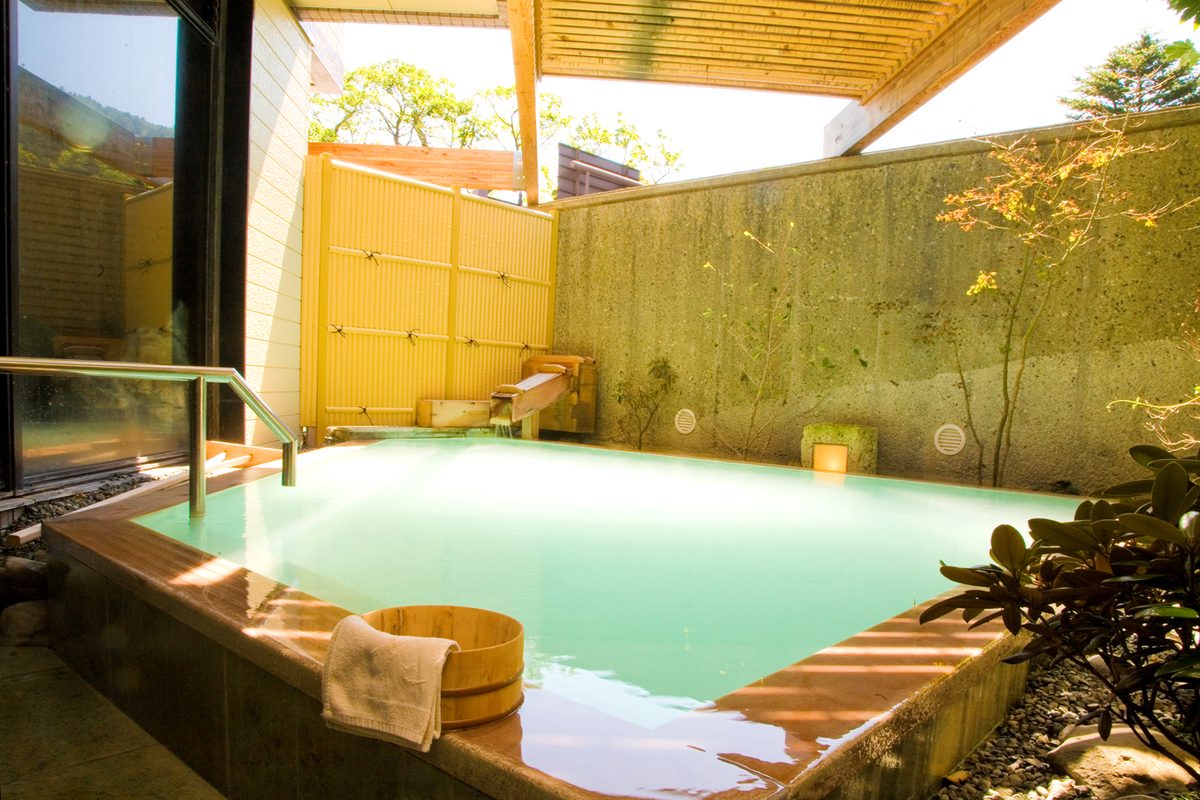
Hotel websites and onsen ads in Japan often boast of gensen kakenagashi (源泉かけ流し). The phrase sounds special, but what does it actually mean, and is a recirculated bath a bad thing? This guide explains the difference between free-flowing and recirculating baths, why some baths add water, heat it or use chlorine, and how to check what a bath really does by reading the sign the law requires. It is based on the Hot Spring Act, the Ministry of the Environment, the Ministry of Health, Labour and Welfare, the Japan Fair Trade Commission and the Japan Spa Association, checked in October 2026.
- The short answer: what gensen kakenagashi means
- Free-flowing vs recirculated, in one picture
- Why baths add water, heat it, filter it or disinfect it
- What the law makes facilities post, and what ads may not say
- How to check a bath before you go
The short answer
Gensen means the spring source, and kakenagashi means letting water pour in and flow away. Together, the phrase describes a bath where fresh spring water keeps flowing in and the water that overflows is let out instead of being pumped back into the bath. The opposite is a recirculating bath (循環式, junkan-shiki), where the bath water is filtered, disinfected, heated and returned to the tub.
Neither is "fake". Both use hot spring water if the facility says so, and both may add water, heat the water or disinfect it. The difference is what happens to the water after you have bathed in it. The reliable way to know is the sign on the wall, which must say whether the water is diluted, heated, recirculated or disinfected, and why.
Free-flowing and recirculated, side by side
The Ministry of Health, Labour and Welfare explains that a recirculating bath is used to reduce the amount of hot spring water or tap water needed. The water passes through a hair catcher, is disinfected (chlorine is recommended), filtered and warmed again, then goes back into the tub. Its manual asks operators to keep the free chlorine at usually about 0.4 milligrams per liter, and not above 1.0.
The reason is hygiene: Legionella bacteria can grow in filters and pipes. The same manual says that free-flowing baths are not automatically safe either. Removing slime from tubs, tanks and pipes is the most important measure there too, and disinfecting the bath water with chlorine as needed is recommended. So a free-flowing bath may still smell slightly of chlorine.
Why baths add water, heat it or disinfect it
Kyoto Prefecture's form for the onsen sign gives examples of the reasons facilities write. They show that each step usually has a practical purpose:
- Water added (加水): the source is too hot, there is not enough spring water, only in hot seasons, or the water is strongly acidic or alkaline and needs diluting.
- Heated (加温): the source is too cool for bathing, only in cold seasons, or for hygiene because the water is stored in a tank.
- Recirculated and filtered (循環・ろ過): for hygiene, to protect the hot spring resource, or to keep the temperature even.
- Bath additives (入浴剤): for a seasonal touch or a nicer color; the product name must be given.
- Disinfected (消毒): for hygiene, usually with chlorine-based chemicals.
Some springs come out of the ground far too hot to bathe in, and some too cool, so adding water or heat is often what makes a bath usable at all. Whether a bath feels good to you depends on more than this one label.
What the law requires on the sign
Article 18 of the Hot Spring Act requires every facility offering hot spring water for public bathing or drinking to post its contents, contraindications and bathing precautions where guests can see them. Since 2005, the enforcement ordinance has also required facilities to state, if they do it, that they:
- add water, and why;
- heat the water, and why;
- recirculate the water (including whether it is filtered), and why;
- add a bath additive (one that changes color, scent or effect and that bathers can't easily tell), with its name and why, or disinfect the water, with the method and why.
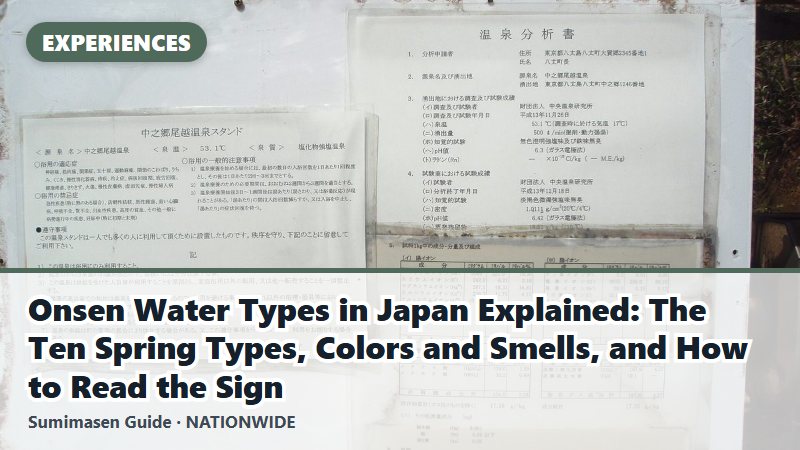
One more detail: the Ministry of the Environment notes that hot spring water can change after it comes out of the ground, as it meets the air and some gases escape. The sign should in principle be based on an analysis at the facility, but it may use the analysis at the source if there is no difference, and facilities should make it clear when the listed indications are based on the source.
What ads may not say
- "100% source water." In a 2003 report, the Japan Fair Trade Commission said that claiming "源泉100%" or "天然温泉100%" while adding water, heating or recirculating the water may mislead consumers.
- "Natural hot spring." The same report said many consumers assume 天然温泉 means no added water, heating or recirculation, so facilities using the phrase should also give that information.
- Old signs. The Japan Spa Association used to lend facilities a "natural hot spring" display board, but it ended the scheme when all boards expired on February 28, 2019. If you see one, it is no longer current.
How to check before you go
- On the facility's website, look for the words 加水, 加温, 循環 and 消毒, often on a page about the bath or the hot spring (温泉). Many inns publish a photo of their sign.
- If you can't find it, ask by email: "Is your bath free-flowing (kakenagashi) or recirculated? Do you add water, heat or chlorine?"
- At the bath, read the sign; it is usually near the entrance or in the changing room. Facilities with several baths may use different water in each.
- Check the spring type on the same sign; our guide to onsen water types explains it.
What to do as a traveler
- If free-flowing water matters to you, look for 源泉かけ流し and check the sign for 循環 (recirculated).
- Don't avoid recirculated baths; they are a normal hygiene system and often the only way to run a big bath.
- Follow the same manners in every bath; see our step-by-step onsen guide.
- To choose a town for your trip, see our guide to onsen towns.
Last reviewed: October 25, 2026. Each facility's water and equipment can change; check the sign on the day.
References
- Tokyo Metropolitan Government: Posting onsen contents, with the text of the law (Japanese, PDF)
- Ministry of the Environment: Amendment to the enforcement ordinance of the Hot Spring Act, 2005 (Japanese, PDF)
- Ministry of the Environment: Standards for posting contraindications and bathing precautions, 2014 (Japanese, PDF)
- Ministry of Health, Labour and Welfare: Revision of the manual for preventing Legionella in recirculating baths, 2019 (Japanese, PDF)
- Ministry of Health, Labour and Welfare: Manual for preventing Legionella in recirculating baths, with Q&A (Japanese, PDF)
- Kyoto Prefecture: Form and examples for the onsen sign (Japanese, PDF)
- Saitama Prefecture: Onsen labeling, quoting the Japan Fair Trade Commission's 2003 report (Japanese)
- Japan Spa Association: The natural hot spring mark and display board (Japanese)